1. Introduction
The global transition toward a low-carbon energy system has fundamentally reshaped the demand landscape for electrochemical energy storage technologies. At the center of this transformation are lithium-ion batteries (LIBs), which have become indispensable for electric mobility, renewable energy integration, and grid stabilization. Rapid growth in electric vehicle (EV) deployment, alongside increasing penetration of intermittent renewable energy sources such as wind and solar, has driven LIB production to unprecedented levels (Islam & Iyer-Raniga, 2022; Peters & Weil, 2016; Tawonezvi et al., 2023). As energy systems decarbonize, batteries are no longer peripheral technologies but core infrastructure, linking mobility, electricity, and industrial sectors into an increasingly electrified global economy (Dar et al., 2025; Rapier, 2024).
However, this acceleration comes with profound sustainability challenges. Projections suggest that global EV stocks may exceed 170 million vehicles by 2030, placing extraordinary pressure on raw material supply chains that underpin battery manufacturing (Barman et al., 2023; Sato & Nakata, 2020). The rechargeable battery market is expected to grow to nearly USD 200 billion within the next decade, underscoring the scale of industrial expansion underway (Dar et al., 2025). Yet such growth intensifies concerns related to resource depletion, environmental degradation, and geopolitical dependency, particularly for critical raw materials (CRMs) such as lithium, cobalt, nickel, manganese, and graphite (European Commission, 2023; Neidhardt et al., 2022).
The sustainability of LIB technologies is increasingly constrained not by performance limitations, but by material availability and supply risk. Many battery-relevant metals are geographically concentrated, often in regions characterized by political instability, weak governance frameworks, or limited environmental oversight (Ali et al., 2017; International Energy Agency, 2023; Pommeret et al., 2022). Cobalt extraction in the Democratic Republic of the Congo, for example, has become emblematic of the social and environmental challenges embedded in battery supply chains, including child labor, ecosystem degradation, and water contamination (Velázquez-Martínez et al., 2019). At the same time, demand for lithium and nickel is projected to outpace current mining capacity within the next decade, increasing price volatility and strategic vulnerability (Gielen, 2021; Mahnoor et al., 2025).
Beyond extraction impacts, the end-of-life management of LIBs represents a growing environmental and public health concern. Improper disposal of spent batteries poses risks related to electrolyte leakage, fire hazards, and heavy-metal contamination (Ajiboye & Dzwiniel, 2023; Chen & Ho, 2018). Without effective recovery systems, valuable materials are irreversibly lost from the economy, exacerbating both resource scarcity and waste accumulation. These challenges have positioned battery recycling not merely as a waste management solution, but as a strategic pillar for future energy security (Global Battery Alliance, 2020; Doose et al., 2021).
In this context, the circular economy (CE) framework has emerged as a guiding paradigm for rethinking battery value chains. Circular strategies emphasize extending product lifetimes, enabling second-life applications, and recovering high-value materials at end-of-life to displace primary extraction (Geissdoerfer et al., 2017; Olsson et al., 2018). While second-life use of EV batteries for stationary energy storage can delay disposal, recycling remains inevitable to reclaim embedded materials and close material loops (Bobba et al., 2019; Martinez-Laserna et al., 2018). Industrial LIB recycling currently relies on pyrometallurgical, hydrometallurgical, and emerging direct recycling approaches, each with distinct recovery efficiencies, environmental trade-offs, and economic implications (Harper et al., 2019; Wang et al., 2020).
Despite significant technological progress, determining which materials should be prioritized for recovery remains a subject of debate. This uncertainty is closely tied to how “resource depletion” is conceptualized and measured within life cycle assessment (LCA) frameworks. Resource Depletion Potential (RDP) indicators vary widely across life cycle impact assessment (LCIA) methodologies, reflecting differing assumptions about scarcity, substitutability, and future extraction effort (Cerdas et al., 2018; Peters & Weil, 2016). As a result, assessments of the same battery system can yield contrasting conclusions about which components are most critical, complicating policy development and industrial decision-making (Martin et al., 2022; McKerracher, 2019).
Reserve-based approaches, such as the CML methodology, compare current extraction rates with estimated geological stocks, but results are highly sensitive to how reserves are defined—whether as economically viable, technically recoverable, or absolute crustal abundance (Peters & Weil, 2016). In contrast, future-effort approaches like ReCiPe and Eco-indicator 99 emphasize the additional energy or economic cost required to extract lower-grade ores in the future, often amplifying the influence of abundant materials such as aluminum or manganese (Peters & Weil, 2016; Kawajiri et al., 2022). Dissipation-based indicators, including the anthropogenic stock-extended abiotic depletion potential (AADP), focus on materials lost from the economic cycle, highlighting the importance of recycling efficiency (Løvik et al., 2018). Thermodynamic approaches such as cumulative exergy demand (CExD) further extend the analytical lens by linking scarcity to fundamental energetic constraints (Ferro & Bonollo, 2019).
Systematic evidence increasingly shows that these methodological choices strongly influence perceived sustainability outcomes. Notably, several studies identify battery management systems (BMS) and electronic components as disproportionately large contributors to RDP due to the presence of precious metals such as gold, silver, and tantalum, despite their relatively small mass fraction (Peters & Weil, 2016; Hofmann et al., 2018). Within battery cells themselves, cobalt, nickel, and copper consistently emerge as critical due to high supply risk and limited recycling rates, while the role of lithium remains method-dependent and contested (Neidhardt et al., 2022; European Commission, 2017).
The choice of functional unit further complicates comparisons across battery chemistries. When assessed per unit mass, lithium-iron-phosphate (LFP) and sodium-ion batteries appear favorable because they avoid high-impact metals such as cobalt and nickel (Zhang et al., 2021). However, when evaluated per unit of energy delivered (kWh), high-energy-density chemistries such as NCM or NCA can demonstrate lower overall resource depletion due to reduced material requirements (Cerdas et al., 2018; Peters & Weil, 2016). These findings underscore the importance of harmonized assessment frameworks in guiding sustainable battery design and policy.
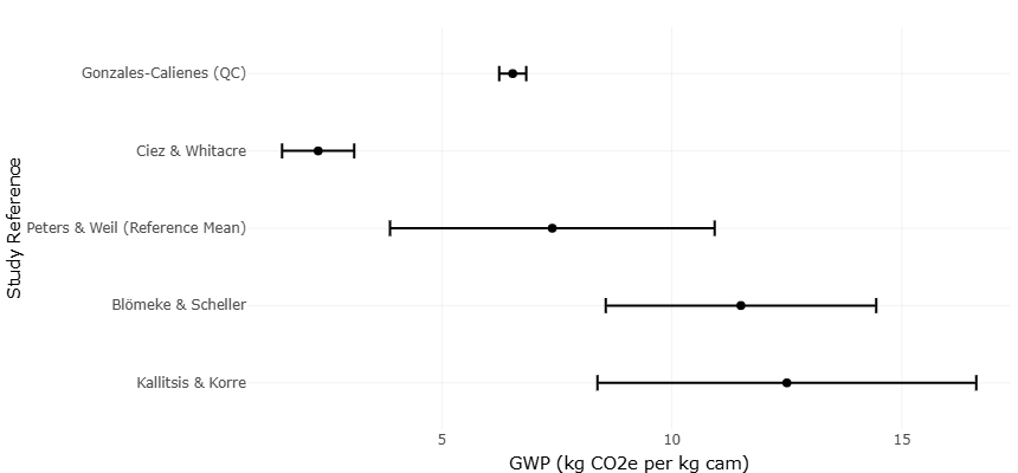
In parallel, growing attention has been directed toward the climate benefits of recycling, particularly through reductions in the global warming potential (GWP) associated with cathode active material (CAM) production. Regional electricity grid composition has been shown to significantly influence GWP outcomes, with low-carbon grids enabling substantially lower emissions for recycled materials compared to primary production (Gonzales-Calienes et al., 2023; Ciez & Whitacre, 2019). Such variability highlights the need for geographically contextualized assessments when evaluating recycling pathways.
Against this backdrop, systematic reviews and meta-analyses play a critical role in synthesizing fragmented evidence, identifying consistent patterns across methodologies, and quantifying uncertainty. By integrating data on lithium recovery efficiency, RDP indicators, and GWP outcomes, a more coherent understanding of the environmental performance of circular battery systems can be achieved (Mahnoor et al., 2025; Tawonezvi et al., 2023). This study builds on that foundation, aiming to clarify how methodological choices shape sustainability conclusions and to identify leverage points where recycling and policy interventions can most effectively reduce resource depletion and climate impacts.
Ultimately, advancing toward a truly sustainable battery economy requires more than incremental efficiency gains. It demands transparent assessment methods, robust recycling infrastructure, supportive policy frameworks such as extended producer responsibility, and strategic alignment between material criticality and recovery priorities (Helms et al., 2016; Global Battery Alliance, 2020). By situating LIB recycling within a systematic and methodologically explicit sustainability framework, this work contributes to the evidence base needed to support resilient, low-carbon energy systems in the decades ahead.
Absolutely! Based on your systematic review and meta-analysis framework and PUBMED-style reporting requirements, here’s a Materials and Methods section in ~1000 words with four sub-sections: Study Design, Literature Search and Selection Criteria, Data Extraction and Processing, and Data Analysis & Statistical Methods. I’ve humanized it, kept the logical flow, and made it suitable for journal submission.