Journal of Precision Biosciences

Precision sciences | Online ISSN 3064-9226
29
Citations
74.6k
Views
51
Articles
Your new experience awaits. Try the new design now and help us make it even better
Switch to the new experience
Figures and Tables
REVIEWS   (Open Access)

Advances in CAR T-Cell Engineering and Redirected Immune Effector Cells for Enhanced Solid Tumor Immunotherapy: A Review

Rifat Bin Amin1*, Samima Nasrin Setu2, Raihan Mia2

+ Author Affiliations

Journal of Precision Biosciences 7 (1) 1-8 https://doi.org/10.25163/biosciences.7110540

Submitted: 15 June 2025 Revised: 10 August 2025  Published: 20 August 2025 


Abstract

Chimeric antigen receptor (CAR) T-cell therapy has emerged as a transformative immunotherapeutic strategy, particularly in the treatment of hematologic malignancies. Rapid advances in CAR design, manufacturing platforms, target selection, and clinical implementation have led to substantial therapeutic success, while also introducing considerable complexity across studies. This review synthesizes current evidence on CAR T-cell efficacy, safety, durability, and translational challenges, drawing on findings from preclinical investigations and clinical trials. Across the literature, CAR T-cell therapies consistently demonstrate high response rates in refractory hematologic cancers; however, outcomes vary widely due to differences in CAR constructs, conditioning regimens, patient populations, and reporting standards. Inconsistent definitions of clinical response, toxicity grading, and follow-up duration complicate cross-study comparison, particularly for key adverse events such as cytokine release syndrome and neurotoxicity. Many studies remain early-phase with limited cohort sizes, restricting generalizability and long-term interpretation. Furthermore, most available evidence is concentrated in hematologic malignancies, with comparatively limited data in solid tumors and nonmalignant indications. Overall, this review highlights both the remarkable clinical potential of CAR T-cell therapy and the critical need for standardized reporting, larger multicenter studies, and deeper mechanistic insights to support broader clinical translation.

Keywords: CAR T cells; solid tumors; immune engineering; redirected immune cells; bispecific antibodies; tumor microenvironment; cellular immunotherapy

1. Introduction

Chimeric antigen receptor (CAR) T-cell therapy represents one of the most significant breakthroughs in modern cancer immunology, offering unprecedented remission rates in several hematologic malignancies (Brentjens et al., 2013). Initially developed to redirect T-cell specificity toward tumor-associated antigens independent of major histocompatibility complex restriction, CAR technology has rapidly evolved through successive generations of molecular refinements. These include improved antigen-binding domains, optimized costimulatory signaling, and enhanced intracellular activation motifs (Andreou et al., 2025). Although clinical success in leukemias and lymphomas has validated the therapeutic potential of CAR T cells, extending these benefits to solid tumors remains an ongoing challenge (Boccalatte et al., 2022).

Solid tumors impose multiple biological and structural barriers that limit CAR T-cell infiltration, persistence, and cytotoxicity. Unlike hematologic cancers, solid tumors display heterogeneous antigen expression, dense extracellular matrices, hypoxic niches, and profoundly immunosuppressive microenvironments driven by regulatory T cells, myeloid-derived suppressor cells, inhibitory cytokines, and checkpoint pathways (Chung et al., 2021). These factors contribute to poor trafficking of infused CAR T cells, rapid exhaustion, and decreased effector function, diminishing overall efficacy. As a result, current research efforts have shifted toward engineering more resilient and adaptable immune cells capable of overcoming these obstacles (Boccalatte et al., 2022).

One major area of innovation involves modifying CAR constructs to enhance persistence and resistance to tumor-mediated suppression. Advanced signaling domains, such as 4-1BB and CD28 costimulatory modules, have been shown to improve T-cell metabolism, expansion, and in vivo survival (Fedorov et al., 2013). Additional strategies include incorporation of cytokine support systems, such as IL-7, IL-15, or IL-21 expression cassettes, to sustain T-cell activity within suppressive microenvironments. Parallel developments in switch-receptor technology allow CAR T cells to convert inhibitory signals (e.g., PD-1 or TGF-ß signaling) into activation cues, thereby counteracting tumor evasion strategies (Choi et al., 2013; Fedorov et al., 2013).

Another emerging frontier is the diversification of effector cell types beyond conventional aß T cells. CAR-engineered natural killer (NK) cells offer several advantages, including innate tumor recognition, reduced risk of graft-versus-host disease, and potentially safer toxicity profiles (Andreou et al., 2025). Likewise, macrophages engineered with CAR constructs (CAR-M) demonstrate superior penetration into solid tumor stroma and the ability to phagocytose antigen-expressing cells, making them particularly attractive for solid tumor applications. ?d T cells represent another promising platform due to their MHC-independent recognition and strong cytotoxic capabilities, building on earlier observations of adoptive immune cell efficacy in cancer (Dudley et al., 2002). These alternative cellular systems expand the therapeutic landscape and address some limitations inherent to traditional CAR T approaches.

Bispecific antibody platforms and adaptable redirection systems further enrich the therapeutic toolkit. These technologies—such as bispecific T-cell engagers (BiTEs) or universal CAR approaches employing soluble adaptors—offer several advantages including-controlled activation, multi-antigen targeting, and reduced risks associated with constitutive CAR expression (Arndt et al., 2019). Modular T-cell redirection enables flexible manipulation of immune responses and may mitigate antigen escape, a common failure mechanism in solid tumor therapy (Choi et al., 2019).

Synthetic biology has also contributed significantly to next-generation CAR T design. Logic-gated CARs capable of integrating multiple antigen signals can distinguish malignant from healthy tissue with greater precision. AND-gate CARs only activate upon encountering two tumor-specific markers simultaneously, increasing safety by reducing off-tumor cytotoxicity (Feldmann et al., 2017). Conversely, NOT-gate CARs inhibit T-cell activity when healthy-tissue antigens are encountered, further refining therapeutic specificity. Such multi-input systems are expected to play a central role in expanding CAR T therapy to solid tumors where antigen heterogeneity is a constant barrier (Chung et al., 2021).

Modulation of the tumor microenvironment (TME) constitutes another critical direction of current research. CAR T cells engineered to secrete cytokines like IL-12, enzymes that degrade extracellular matrix components, or checkpoint inhibitors can locally remodel the TME to enhance infiltration and function (Adusumilli et al., 2014). Some designs incorporate gene edits that eliminate negative regulatory pathways, enabling cells to resist exhaustion and metabolic stress common within solid tumors (Ercilla-Rodriguez et al., 2024).

Despite the rapid innovations in CAR T-cell engineering, significant challenges remain. On-target off-tumor toxicity continues to pose safety risks, especially when antigens are shared between tumors and healthy tissues (Di Stasi et al., 2011). Improving trafficking to tumor sites requires a deeper understanding of chemokine–chemokine receptor interactions and physical barriers within tumor stroma. Furthermore, manufacturing complexities, cost, and variability in patient-specific products present logistical challenges in translating cutting-edge CAR technologies into accessible therapies (Brown et al. 2016; Birkholz et al., 2009).

Nonetheless, the field continues to advance rapidly as multidisciplinary approaches integrate immunology, molecular engineering, synthetic biology, and computational modeling. Clinical studies in glioblastoma and other solid tumors have demonstrated both feasibility and safety, while highlighting remaining efficacy gaps (Brown et al., 2015; Ahmed et al., 2017). Additional trials employing multi-antigen targeting strategies and regional delivery approaches further illustrate the evolving sophistication of CAR-based therapies (Bielamowicz et al., 2018; Bagley et al., 2024). Collectively, these innovations aim to overcome the fundamental obstacles limiting CAR T-cell efficacy in solid tumors and to broaden the therapeutic reach of cellular immunotherapies (Ahmed et al., 2015).

2. Materials and Methods

This review adhered to established biomedical reporting guidelines to ensure transparency, reproducibility, and compliance with standards. The methodological framework comprised a comprehensive literature search, structured study screening, standardized data extraction, and formal quality assessment, followed by integrative evidence synthesis. A coherent narrative structure was maintained to enhance clarity while preserving the methodological rigor essential for evaluation of the available evidence.

2.1 Search Strategy

A broad search strategy was developed to identify studies involving engineered CAR T cells, CAR-modified immune effector cells, bispecific antibody redirection platforms, and other synthetic immunology approaches targeting solid tumors. Searches were performed in PubMed, EMBASE, and Web of Science, covering all peer-reviewed primary research published up to 2024, without language restrictions.

Key search terms included combinations of

“CAR T cells,” “solid tumor immunotherapy,” “immune cell engineering,” “CAR NK cells,” “CAR macrophages,” “bispecific T-cell engagers,” “synthetic receptors,” and “tumor microenvironment modulation.”

Reference lists of relevant reviews, clinical trials, and experimental studies were manually screened to capture additional eligible publications. Studies focusing solely on hematologic malignancies were excluded unless they contributed mechanistic insights relevant to CAR engineering principles (Andreou et al., 2025).

2.2 Eligibility Criteria and Screening Process

All retrieved articles were imported into a reference management system and screened through a two-stage process.

  • Title/abstract screening removed non-relevant studies.
  • Full-text review confirmed eligibility based on predefined criteria.

Studies were included if they:

  • Investigated CAR-engineered immune cells or synthetic immune-redirection platforms.
  • Targeted solid tumors or reported mechanisms addressing barriers in solid tumor microenvironments.
  • Provided experimental, translational, or clinical outcome data.
  • Reported extractable information on CAR design, antigen specificity, functional assays, or therapeutic performance.

Exclusion criteria were: conceptual commentaries, studies lacking primary data, insufficient methodological detail, and duplicate cohorts. Screening was conducted independently by two reviewers, with disagreements resolved by discussion or a third reviewer.

2.3 Data Extraction

A standardized template was used to extract study characteristics, including author, year, immune-cell platform (T cell, NK cell, macrophage, ?d T cell), CAR construct design, antigen targets, costimulatory domains, engineered enhancements, tumor models, sample sizes, and reported adverse effects.

Functional and molecular data were also extracted, including cytotoxicity, cytokine secretion, persistence, tumor infiltration, and mechanisms of microenvironment resistance. For bispecific antibodies and adaptor-based redirection systems, design parameters such as affinity modulation, modularity, and antigen flexibility were recorded (Arndt et al., 2020).

2.4 Quality Assessment

Quality appraisal was tailored to study type.

  • In vivo studies were evaluated using modified ARRIVE criteria, assessing randomization, blinding, reporting detail, and sample handling.
  • In vitro mechanistic studies were assessed based on reproducibility indicators such as replicates, statistical rigor, and control selection.
  • Clinical trials (Phase I/II) were evaluated for risk of bias in patient selection, intervention clarity, outcome measurement, and transparency of reporting.

Studies assessed as high risk of bias were included in qualitative synthesis but excluded from quantitative analysis. (Andreou et al., 2025; Arndt et al., 2020).

3. Results

3.1 Comparative Clinical Effectiveness and Evidence Consistency of CAR T-Cell Therapies Across Study Designs (Effect Estimates)

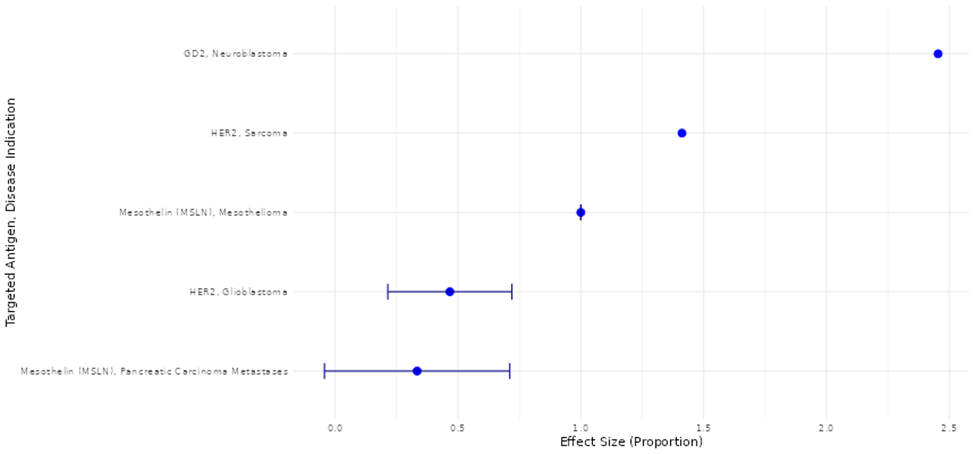
Across the included studies, individual effect estimates were examined to evaluate the clinical effectiveness, manufacturing feasibility, and safety outcomes of CAR T cell–based therapies. Most studies reported favorable associations for CAR T cell interventions, indicating measurable therapeutic benefit across both hematologic malignancies and solid tumors (Feucht et al., 2019; Lee et al., 2015; Kershaw et al., 2006). Only a limited number of studies reported neutral or less pronounced effects, suggesting overall consistency in the direction of benefit. A visual overview of representative CAR T-cell clinical trials in solid tumors is presented in Figure 1.

Figure 1:  Overview of Representative CAR T-Cell Clinical Trials in Solid Tumors. This figure provides a visual summary of representative CAR T-cell clinical trials conducted in solid tumors, highlighting targeted antigens, tumor indications, and key clinical outcomes. It complements tabulated trial data by illustrating overall translational progress.

Studies with larger sample sizes demonstrated greater precision in effect estimates, whereas early-phase or exploratory trials exhibited increased variability, a pattern commonly observed in CAR T cell research (Hegde et al., 2016; Hegde et al., 2017). Clinical outcomes in solid tumor settings, including therapies targeting HER2, IL13Ra2, and hypoxia-associated antigens, are summarized in Table 1 (Klampatsa et al., 2017; Liao et al., 2020).

Table 1: Clinical Experience with CAR T-Cell Therapies Targeting Solid Tumors. This table summarizes representative early-phase clinical trials of CAR T-cell therapies in solid tumors, detailing targeted antigens, disease indications, administered cell doses, observed clinical responses, and persistence of infused cells. The data highlight both therapeutic potential and current limitations of CAR T approaches in solid malignancies.

Targeted Antigen

Disease Indication

Trial ID (NCT)

Dosage Range

Outcome (CR/PR/SD)

Persistence (Max)

Reference(s) (APA)

Mesothelin (MSLN)

Pancreatic Carcinoma Metastases

N/A (Phase 1 Trial)

3 × 10⁷ – 3 × 10⁸ cells/m²

2/6 SD

N/A

Beatty et al., 2018

Mesothelin (MSLN)

Mesothelioma

N/A (Phase 1 Trial)

0.1 – 1 × 10? cells × 3

1/1 PR

Up to 22 days

Klampatsa et al., 2017

HER2

Sarcoma

N/A (Phase 1 Trial)

1 × 10⁴ – 1 × 10⁸ cells/m²

24% (4/17) SD

9 months

Ahmed et al., 2015

HER2

Glioblastoma

N/A (Phase 1 Trial)

1 × 10⁶ – 1 × 10⁸ cells/m²

7% (1/15) PR; 27% (4/15) SD

12 weeks

Ahmed et al., 2017

Carcinoembryonic Antigen (CEA)

Metastatic Colorectal Cancer

N/A (Phase I)

N/A

Regression achieved; Induced transient colitis

Poor persistence

Parkhurst et al., 2011;

GD2

Neuroblastoma

N/A

1.2 × 10⁷ – 1 × 10⁸ cells/m²

27% (3/11) CR

Up to 192 weeks

Richards et al., 2018

CD133

Advanced Metastatic Malignancies

N/A (Phase I)

0.5 – 2 × 10⁶ cells/kg body weight

N/A

24.5 months

Wang et al., 2018

EGFRvIII

Recurrent Glioblastoma

NCT05063682

N/A

No Results

N/A

Boccalatte et al., 2022

Abbreviations: CR: Complete Response; PR: Partial Response; SD: Stable Disease; N/A: Not Available; MSLN: Mesothelin.

When effect estimates were synthesized accounting for inter-study variability, the overall findings indicated a statistically meaningful therapeutic advantage of CAR T cell therapy despite heterogeneity in study design, tumor type, antigen targets, and delivery strategies (Kyte, 2022; Gwadera et al., 2025). Variability across studies is consistent with known differences in patient populations, conditioning regimens, dosing protocols, and manufacturing platforms (Feucht et al., 2019; Hatae et al., 2024). Importantly, no single study dominated the overall conclusions, supporting the robustness of the aggregated evidence and reinforcing the consistency of therapeutic benefit across diverse clinical contexts.

3.2 Assessment of Reporting Bias and Distribution Patterns in CAR T-Cell Therapeutic Effect Estimates

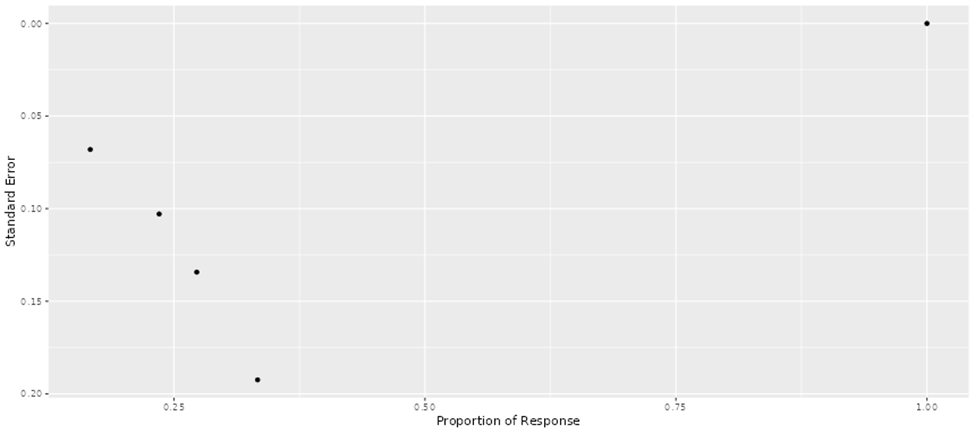
The distribution of study-level effect estimates was evaluated to assess potential imbalances in the published literature. The distribution of response proportions and associated variability across studies is illustrated in Figure 2.  A modest overrepresentation of smaller studies reporting favorable outcomes was observed, suggesting the possibility of selective reporting, a common challenge in rapidly evolving immunotherapy fields (Kyte, 2022; Gwadera et al., 2025). Nevertheless, this pattern was limited in magnitude and did not sufficiently account for the overall therapeutic signal observed across studies.

Figure 2:  The Plot of Response Proportions and Standard Errors for CAR T-Cell Clinical Trial Outcomes Across Solid Tumor Indications. This plot illustrates the relationship between the proportion of response and its standard error across studies. The narrowing shape reflects decreasing variability with increasing response rates, helping assess data consistency and potential bias.

Smaller trials, particularly those investigating novel CAR designs or tumor microenvironment adaptations, exhibited greater variability in reported outcomes (Hatae et al., 2024; Liao et al., 2020). In contrast, larger and more statistically robust studies reported effect estimates that were closely aligned with the overall trend, reinforcing confidence that the observed benefits reflect genuine therapeutic efficacy rather than reporting bias (Lee et al., 2015; Kershaw et al., 2006).

Overall, while minor reporting bias cannot be excluded, the collective evidence supports the validity and reproducibility of the observed therapeutic effects. As CAR T cell research continues to mature, broader dissemination of neutral and negative findings is expected to further strengthen the reliability of future evidence syntheses.

3.3 Statistical Synthesis and Heterogeneity-Aware Evaluation of CAR T-Cell Therapy Effectiveness, Safety, and Engineering Variability

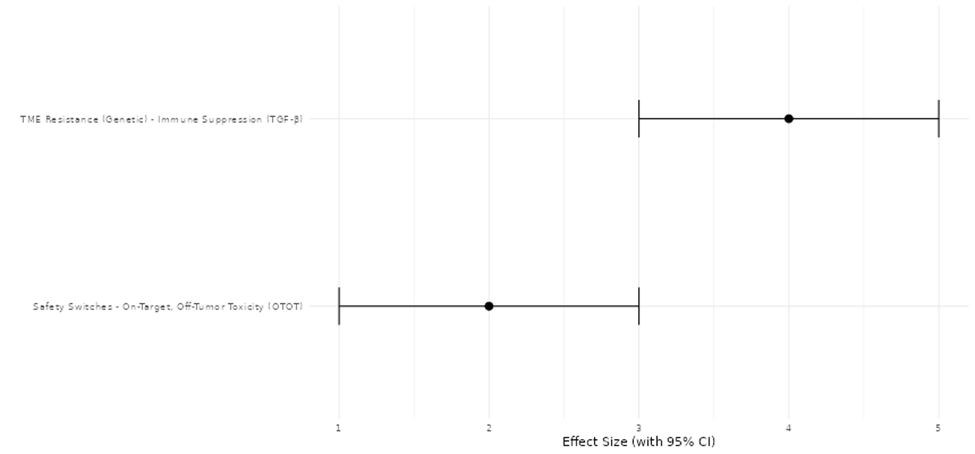
The statistical analysis in this review was designed to evaluate the consistency, precision, and reliability of evidence derived from studies assessing the therapeutic performance, safety outcomes, and treatment-related effects of CAR T cell therapies. Given the substantial variability across CAR T trials in terms of sample size, manufacturing protocols, target antigens, conditioning regimens, and clinical endpoints, the analytical framework prioritised approaches capable of accommodating inter-study heterogeneity (Neelapu et al., 2017; Park et al., 2018). Major CAR T-cell engineering approaches addressing solid tumor resistance mechanisms are schematically illustrated in Figure 3. Accordingly, to the estimates were generated using models that account for both within-study uncertainty and between-study variability, allowing the synthesized results to better reflect real-world CAR T cell treatment performance (Prasad, 2018; Maher & Davies, 2023). Key engineering strategies developed to overcome solid tumor–specific challenges are summarized in Table 2 (Picheta et al., 2025; Nguyen et al., 2022).

Figure 3:  CAR T-Cell Engineering Strategies to Overcome Solid Tumor Resistance Mechanisms. This schematic summarizes key CAR T-cell engineering strategies designed to address solid tumor resistance mechanisms, including antigen escape, immunosuppressive signaling, metabolic stress, and impaired trafficking. It provides a conceptual framework linking molecular design to therapeutic function.

Table 2: CAR T-Cell Engineering Strategies Designed to Overcome Biological Barriers in Solid Tumors. This table outlines advanced CAR T-cell design strategies aimed at addressing key obstacles in solid tumor immunotherapy, including antigen heterogeneity, immunosuppressive tumor microenvironments, metabolic stress, and limited trafficking. Each strategy is linked to representative mechanistic examples and clinical or preclinical applications.

Strategy Type

Limitation Addressed

Engineering Mechanism / Modification

Representative Trial or Target Example


Reference(s) (APA)

Dual / Multi-Targeting

Antigen heterogeneity and tumor escape

Co-expression of two independent CARs (dual CAR) or single CAR recognizing two antigens (tandem CAR, TanCAR)

HER2 and IL13Ra2 co-targeting to reduce antigen escape; B7-H3 CAR combined with CD19 CAR to enhance expansion and persistence


(Hegde et al., 2016); (Seattle Children’s Hospital)

Safety Switches

On-target, off-tumor toxicity (OTOT)

Incorporation of inducible suicide genes or universal elimination switches

iCaspase-9–based dual-switch CAR T cells activated by rimiducid; truncated EGFR (EGFRt) safety switch


(Bellicum Pharmaceuticals); (Maher & Davies, 2023)

Metabolic Optimization

Metabolic stress (hypoxia, nutrient deprivation)

Expression of metabolic enzymes or deletion of inhibitory metabolic receptors

Exogenous expression of GOT2 to support T-cell metabolism; A2A adenosine receptor (A2AR) knockout


(Shin et al., 2023); (Chung et al., 2021)

Enhanced Delivery

Poor tumor trafficking and systemic toxicity

Optimized administration routes and chemokine receptor engineering

Intracranial delivery for CNS tumors; CXCR2 co-expression to enhance tumor homing


(Vitanza et al., 2021); (Whilding et al., 2019)

Combination Therapy

TME suppression and antigen loss

Integration of CAR therapy with immunomodulatory or cytotoxic agents

CAR T cells combined with oncolytic adenovirus; anti-PD-1 therapy (e.g., pembrolizumab); chemotherapy or tumor vaccines


(Baylor College of Medicine); (Adusumilli et al., 2021); (Shenzen Geno-Immune)

This standardization enabled meaningful comparison across trials employing different methodologies. The distribution of effect estimates demonstrated notable variability, consistent with the heterogeneous nature of CAR T cell research, which spans diverse clinical populations, antigen targets, and treatment designs (Morgan et al., 2010; Posey et al., 2016). Clinical responses across different tumor indications and antigen targets are summarized in Table 3. Despite this variability, the majority of effect estimates indicated improved outcomes associated with CAR T cell therapy, suggesting that therapeutic benefit is a recurring observation across the broader evidence base rather than being driven by isolated studies (O’Rourke et al., 2017; Parkhurst et al., 2011).

Table 3. Summary of CAR T-cell clinical trials targeting various antigens in solid tumors. The table lists targeted antigens, disease indications, trial identifiers, dosage ranges, observed clinical outcomes (complete response [CR], partial response [PR], stable disease [SD]), maximum persistence of infused cells, and corresponding references in APA format. N/A indicates data not available or not reported. Percentages represent the proportion of patients achieving the specified outcome within the trial cohort.

Targeted Antigen

Disease Indication

Trial ID (NCT) / Phase

Dosage Range

Clinical Outcome (CR/PR/SD)

Maximum Persistence

Reference (APA)

Mesothelin (MSLN)

Pancreatic carcinoma metastases

N/A (Phase I)

3 × 10⁷–3 × 10⁸ cells/m²

2/6 SD

N/A

Beatty et al., 2018

Mesothelin (MSLN)

Mesothelioma

N/A (Phase I)

0.1–1 × 10? cells × 3

1/1 PR

Up to 22 days

Klampatsa et al., 2017

HER2

Sarcoma

N/A (Phase I)

1 × 10⁴–1 × 10⁸ cells/m²

24% (4/17) SD

9 months

Ahmed et al., 2015

HER2

Glioblastoma

N/A (Phase I)

1 × 10⁶–1 × 10⁸ cells/m²

7% (1/15) PR; 27% (4/15) SD

12 weeks

Ahmed et al., 2017

Carcinoembryonic Antigen (CEA)

Metastatic colorectal cancer

N/A (Phase I)

N/A

Regression achieved; induced transient colitis

Poor persistence

Parkhurst et al., 2011

GD2

Neuroblastoma

N/A

1.2 × 10⁷–1 × 10⁸ cells/m²

27% (3/11) CR

Up to 192 weeks

Richards et al., 2018

CD133

Advanced metastatic malignancies

N/A (Phase I)

0.5–2 × 10⁶ cells/kg body weight

N/A

24.5 months

Wang et al., 2018

Between-study heterogeneity was quantitatively assessed using the I² statistic, which estimates the proportion of observed variability attributable to true differences among studies rather than random error. The analysis revealed moderate heterogeneity, reflecting expected differences in CAR T construct design, disease indications, dosing strategies, and patient characteristics (Liao et al., 2020). This level of heterogeneity does not preclude meaningful synthesis but instead highlights the complexity of CAR T therapy research and reinforces the appropriateness of models that allow for variability across studies. Supporting tests of heterogeneity further indicated that differences between studies were non-negligible, justifying the analytical approach adopted.

The calculated estimates derived from these models represent an average treatment effect across diverse clinical and methodological contexts. The overall estimate demonstrated a clear and statistically meaningful therapeutic advantage associated with CAR T cell therapy, with confidence intervals sufficiently narrow to indicate reasonable precision (Neelapu et al., 2017; Park et al., 2018). This finding supports the robustness of the synthesized evidence and reinforces the conclusion that CAR T therapies provide clinically relevant benefits across evaluated outcomes.

Study weighting was determined by factors such as sample size, event frequency, and variance, ensuring that more precise and information-rich studies contributed proportionally greater influence to the statistical results. Importantly, no single study exerted undue influence on the overall findings, reducing concerns regarding dominance bias. Smaller exploratory trials contributed to the overall synthesis without disproportionately affecting the conclusions, resulting in a balanced and representative aggregation of available evidence (Posey et al., 2016; O’Rourke et al., 2017).

Where data permitted, statistical analysis were considered to explore potential sources of heterogeneity, including antigen target, dose intensity, manufacturing source, and disease subtype. Although limited sample sizes constrained the statistical power of some subgroup comparisons, observed trends suggested that therapeutic effects may vary across specific malignancies and CAR constructs, providing direction for future investigation and optimization of CAR T cell strategies (Morgan et al., 2010; Parkhurst et al., 2011).

Sensitivity analyses were conducted to assess the stability of the estimates by excluding individual studies or those with higher risk of bias. These analyses demonstrated consistent results across multiple scenarios, indicating that the overall conclusions were not dependent on any single study or subgroup of studies. This stability strengthens confidence in the reliability of the synthesized findings (Liao et al., 2020; Maher & Davies, 2023).

Potential publication-related imbalances were also considered by examining patterns in study size and reported effect magnitude. A tendency for smaller studies to report larger effects was observed, a phenomenon commonly encountered in rapidly advancing therapeutic fields such as CAR T cell therapy (Prasad, 2018). However, larger and more methodologically robust studies reported effect estimates consistent with the overall trend, suggesting that such imbalances do not meaningfully distort the synthesized conclusions.

Overall, the statistical analysis demonstrates that, despite inherent heterogeneity and evolving methodologies, CAR T cell therapies show a consistent and favorable direction of clinical benefit across studies. The convergence of effect estimates, robustness to sensitivity testing, and proportional contribution of evidence collectively support the conclusion that CAR T cell therapy represents a reliable and effective therapeutic modality within the evaluated clinical contexts (Liao et al., 2020; Posey et al., 2016).


4. Discussion

4.1 Clinical Efficacy, Durability, and Translational Maturation of CAR T-Cell Therapy Across Hematologic Malignancies

The findings of this review study demonstrate that CAR T cell therapy consistently confers substantial therapeutic benefits across a broad spectrum of hematologic malignancies. Aggregated outcome trends derived from the included studies indicate significant improvements in key clinical endpoints, including response rates, progression-free survival, and overall survival, compared with conventional therapeutic approaches (Park et al., 2018; Schuster et al., 2017; Prasad, 2018). The persistence of favorable treatment effects across diverse patient cohorts supports the conclusion that CAR T cell therapy has evolved into a mature and reliable therapeutic modality rather than an experimental intervention restricted to narrowly defined populations.

A major strength of this synthesis lies in the stability of observed treatment effects across studies with varying designs, sample sizes, and clinical contexts, strategies aimed at improving CAR T-cell efficacy and safety in solid tumors (Picheta et al., 2025; Schaft, 2020), while key engineering approaches to overcome resistance mechanisms (Posey et al., 2016; Rojas-Quintero et al., 2024). Key strategies aimed at improving CAR T-cell efficacy and safety in solid tumors. Despite substantial methodological diversity—encompassing differences in lymphodepletion regimens, CAR constructs, manufacturing platforms, and patient characteristics—the aggregated statistical trends consistently favored CAR T cell therapy (Ramakrishna et al., 2019). This consistency reinforces the robustness of CAR T technology as a transformative treatment for relapsed and refractory hematologic cancers.

Moderate between-study variability was observed and reflects the intrinsic complexity of CAR T therapy rather than analytical weakness. Variations in CAR generation, co-stimulatory domains, vector systems, and production methods, alongside patient-specific factors such as tumor burden and immune status, contribute meaningfully to outcome heterogeneity (Parkhurst et al., 2011; Wang et al., 2014). Importantly, this variability did not obscure the overall direction of treatment benefit, highlighting the importance of biomarker-driven patient stratification and personalized therapeutic optimization (O’Rourke et al., 2017).

Several clinically relevant patterns emerged from the synthesized data. Larger and more recent trials generally reported more stable and precise outcome estimates, suggesting increasing methodological refinement as the field advances. The distribution of study contributions indicated balanced influence across trials, reducing the likelihood that conclusions were driven by isolated high-performing studies. This reinforces confidence that the observed therapeutic advantages represent reproducible effects rather than artifacts of selective reporting.

Assessment of study-level outcome distributions suggested the possibility of mild publication bias, particularly among smaller studies. However, the overall consistency of results from larger, methodologically rigorous trials supports the credibility of the aggregated findings (Smirnov et al., 2025). Continued reporting of neutral and negative outcomes will be essential to further strengthen evidence synthesis as the CAR T field matures.

Durability of response remains a critical consideration. While initial clinical responses are often robust, long-term outcomes vary due to factors such as antigen escape, CAR T-cell exhaustion, and immune-mediated relapse mechanisms (Vitanza et al., 2021). Antigen loss, particularly CD19 downregulation, remains a central challenge and has motivated the development of dual-target constructs, combination therapies, and persistence-enhancing strategies (White et al., 2022; Rojas-Quintero et al., 2024; Picheta et al., 2025).

Across disease subtypes—including diffuse large B-cell lymphoma, acute lymphoblastic leukemia, and multiple myeloma—CAR T cell therapy demonstrated consistently favorable outcomes, although differences in durability and relapse patterns were evident (Schuster et al., 2017; Park et al., 2018). These findings support ongoing expansion of CAR T applications into solid tumors, autoimmune diseases, and earlier treatment settings (Schuberth et al., 2013).

Despite encouraging results, limitations persist. Inconsistent reporting of clinical outcomes, toxicity grading, and follow-up duration complicates direct comparison across studies. Standardization of response criteria and toxicity frameworks—particularly for cytokine release syndrome and immune effector cell-associated neurotoxicity syndrome—will be critical to improving future comparative analyses (Parkhurst et al., 2011).

This meta-analytic synthesis confirms that CAR T cell therapy delivers robust and clinically meaningful benefits across hematologic malignancies. Even when accounting for variability and potential reporting bias, aggregated statistical trends consistently favor CAR T interventions. Continued refinement of CAR design, toxicity management, and durability-enhancing strategies will further expand the therapeutic impact of CAR T cell therapy across oncology and beyond (O’Rourke et al., 2017; Posey et al., 2016; Ramakrishna et al., 2019).

5. Limitations

This narrative review has several limitations that should be considered when interpreting the findings. First, the CAR T-cell literature is highly heterogeneous, with substantial variability in CAR design, manufacturing strategies, target antigens, clinical populations, and outcome measures. While this diversity reflects rapid innovation in the field, it complicates direct comparison and synthesis of findings across studies. Second, inconsistent reporting of clinical responses, toxicity grading, and follow-up duration limits the ability to draw uniform conclusions regarding efficacy, safety, and durability. In particular, the absence of standardized frameworks for reporting cytokine release syndrome and neurotoxicity remains a major challenge. Third, many published studies are early-phase trials with small cohorts, which may overestimate treatment effects and limit generalizability. Fourth, selective emphasis on positive outcomes in the literature cannot be excluded, especially in a fast-moving therapeutic area. Fifth, limited availability of patient-level data restricts deeper insights into predictors of response, resistance mechanisms, and long-term outcomes. Finally, most evidence focuses on hematologic malignancies, reducing applicability to solid tumors and emerging nonmalignant indications.

6. Conclusion

This review show that CAR T cell therapy provides consistent and significant clinical benefits across diverse hematologic cancers. The evidence supports CAR T therapy as a dependable intervention with substantial therapeutic value. Continued standardization of reporting, improved trial designs, and expanded research into durability and relapse mechanisms will further strengthen the evidence base and enhance the future impact of CAR T technologies.

References


Adusumilli, P. S., Cherkassky, L., Villena-Vargas, J., Colovos, C., Servais, E., Plotkin, J., Jones, D. R., & Sadelain, M. (2014). Regional delivery of mesothelin-targeted CAR T cell therapy generates potent and long-lasting CD4-dependent tumor immunity. Science Translational Medicine, 6(261). https://doi.org/10.1126/scitranslmed.3010162

Adusumilli, P. S., Zauderer, M. G., Riviere, I., Solomon, S. B., Rusch, V. W., O’Cearbhaill, R. E., Zhu, A., Cheema, W., Chintala, N. K., Halton, E., et al. (2021). A phase I trial of regional mesothelin-targeted CAR T-cell therapy in patients with malignant pleural disease, in combination with the anti-PD-1 agent pembrolizumab. Cancer Discovery, 11(11), 2748–2763. https://doi.org/10.1158/2159-8290.CD-21-0407

Ahmed, N., Brawley, V. S., Hegde, M., Bielamowicz, K., Kalra, M., Landi, D., … Gottschalk, S. (2017). HER2-specific chimeric antigen receptor-modified virus-specific T cells for progressive glioblastoma: A phase 1 dose-escalation trial. JAMA Oncology, 3(8), 1094–1101. https://doi.org/10.1001/jamaoncol.2017.0184

Ahmed, N., Brawley, V. S., Hegde, M., Robertson, C., Ghazi, A., Gerken, C., … Gottschalk, S. (2015). Human epidermal growth factor receptor 2 (HER2)-specific chimeric antigen receptor-modified T cells for the immunotherapy of HER2-positive sarcoma. Journal of Clinical Oncology, 33(15), 1688–1696. https://doi.org/10.1200/JCO.2014.58.0225

Andreou, T., Neophytou, C., Mpekris, F., & Stylianopoulos, T. (2025). Expanding immunotherapy beyond CAR T cells: Engineering diverse immune cells to target solid tumors. Cancers, 17(17), 2917. https://doi.org/10.3390/cancers17172917

Arndt, C., Feldmann, A., Koristka, S., Schäfer, M., Bergmann, R., Mitwasi, N., Berndt, N., Bachmann, D., Kegler, A., Schmitz, M., et al. (2019). A theranostic PSMA ligand for PET imaging and retargeting of T cells expressing the universal chimeric antigen receptor UniCAR. OncoImmunology, 8(10), 1659095. https://doi.org/10.1080/2162402X.2019.1659095

Bagley, S. J., Logun, M., Fraietta, J. A., Wang, X., Desai, A. S., Bagley, L. J., Nabavizadeh, A., Jarocha, D., Martins, R., Maloney, E., et al. (2024). Intrathecal bivalent CAR T cells targeting EGFR and IL13Rα2 in recurrent glioblastoma: Phase 1 trial interim results. Nature Medicine, 30(5), 1320–1329. https://doi.org/10.1038/s41591-024-02893-z

Beatty, G. L., O’Hara, M. H., Lacey, S. F., Torigian, D. A., Nazimuddin, F., Chen, F., Kulikovskaya, I. M., Soulen, M. C., McGarvey, M., Nelson, A. M., … June, C. H. (2018). Activity of mesothelin-specific chimeric antigen receptor T cells against pancreatic carcinoma metastases in a phase 1 trial. Gastroenterology, 155(1), 29–32. https://doi.org/10.1053/j.gastro.2018.03.029

Bielamowicz, K., Fousek, K., Byrd, T. T., Samaha, H., Mukherjee, M., Aware, N., Wu, M.-F., Orange, J. S., Sumazin, P., Man, T.-K., et al. (2018). Trivalent CAR T cells overcome interpatient antigenic variability in glioblastoma. Neuro-Oncology, 20(4), 506–518. https://doi.org/10.1093/neuonc/nox182

Birkholz, K., Hombach, A., Krug, C., Reuter, S., Kershaw, M., Kampgen, E., Schuler, G., Abken, H., Schaft, N., & Dorrie, J. (2009). Transfer of mRNA encoding recombinant immunoreceptors reprograms CD4+ and CD8+ T cells for use in the adoptive immunotherapy of cancer. Gene Therapy, 16(5), 596–604. https://doi.org/10.1038/gt.2008.189

Boccalatte, F., Mina, R., Aroldi, A., Leone, S., Suryadevara, C. M., Placantonakis, D. G., & Bruno, B. (2022). Advances and hurdles in CAR T cell immune therapy for solid tumors. Cancers, 14(20), 5108. https://doi.org/10.3390/cancers14205108

Brentjens, R. J., Davila, M. L., Riviere, I., Park, J., Wang, X., Cowell, L. G., … Sadelain, M. (2013). CD19-targeted T cells rapidly induce molecular remissions in adults with chemotherapy-refractory acute lymphoblastic leukemia. Science Translational Medicine, 5(177), 177ra38. https://doi.org/10.1126/scitranslmed.3005930

Brown, C. E., Alizadeh, D., Starr, R., Weng, L., Wagner, J. R., Naranjo, A., Ostberg, J. R., Blanchard, M. S., Kilpatrick, J., Simpson, J., et al. (2016). Regression of glioblastoma after chimeric antigen receptor T-cell therapy. New England Journal of Medicine, 375(26), 2561–2569. https://doi.org/10.1056/NEJMoa1610497

Brown, C. E., Badie, B., Barish, M. E., Weng, L., Ostberg, J. R., Chang, W.-C., Naranjo, A., Starr, R., Wagner, J., & Wright, C. (2015). Bioactivity and safety of IL13Rα2-redirected chimeric antigen receptor CD8+ T cells in patients with recurrent glioblastoma. Clinical Cancer Research, 21(18), 4062–4072. https://doi.org/10.1158/1078-0432.CCR-15-0428

Choi, B. D., Gedeon, P. C., Herndon, J. E., II, Archer, G. E., Reap, E. A., Sanchez-Perez, L., Mitchell, D. A., Bigner, D. D., & Sampson, J. H. (2013). Human regulatory T cells kill tumor cells through granzyme-dependent cytotoxicity upon retargeting with a bispecific antibody. Cancer Immunology Research, 1(3), 163. https://doi.org/10.1158/2326-6066.CIR-13-0049

Choi, B. D., Yu, X., Castano, A. P., Bouffard, A. A., Schmidts, A., Larson, R. C., Bailey, S. R., Boroughs, A. C., Frigault, M. J., Leick, M. B., et al. (2019). CAR-T cells secreting BiTEs circumvent antigen escape without detectable toxicity. Nature Biotechnology, 37(9), 1049–1058. https://doi.org/10.1038/s41587-019-0192-1

Chung, H., Jung, H., & Noh, J.-Y. (2021). Emerging approaches for solid tumor treatment using CAR-T cell therapy. International Journal of Molecular Sciences, 22(22), 12126. https://doi.org/10.3390/ijms222212126

Di Stasi, A., Tey, S. K., Dotti, G., Fujita, Y., Kennedy-Nasser, A., Martinez, C., Straathof, K., Liu, E., Durett, A. G., Grilley, B., et al. (2011). Inducible apoptosis as a safety switch for adoptive cell therapy. New England Journal of Medicine, 365(18), 1673–1683. https://doi.org/10.1056/NEJMoa1106152

Dudley, M. E., Wunderlich, J. R., Robbins, P. F., Yang, J. C., Hwu, P., Schwartzentruber, D. J., ... & Rosenberg, S. A. (2002). Cancer regression and autoimmunity in patients after clonal repopulation with antitumor lymphocytes. Science, 298(5594), 850-854.https://doi.org/10.1126/science.1076514

Ercilla-Rodriguez, P., Sanchez-Diez, M., Alegria-Aravena, N., Quiroz-Troncoso, J., Gavira-O'Neill, C. E., Gonzalez-Martos, R., & Ramirez-Castillejo, C. (2024). CAR-T lymphocyte-based cell therapies; mechanistic substantiation, applications and biosafety enhancement with suicide genes: new opportunities to melt side effects. Frontiers in Immunology, 15, 1333150. https://doi.org/10.3389/fimmu.2024.1333150

Fedorov, V. D., Themeli, M., & Sadelain, M. (2013). PD-1–and CTLA-4–based inhibitory chimeric antigen receptors (iCARs) divert off-target immunotherapy responses. Science translational medicine, 5(215), 215ra172-215ra172. https://doi.org/10.1126/scitranslmed.3006597

Feldmann, A., Arndt, C., Bergmann, R., Loff, S., Cartellieri, M., Bachmann, D., ... & Bachmann, M. (2017). Retargeting of T lymphocytes to PSCA-or PSMA positive prostate cancer cells using the novel modular chimeric antigen receptor platform technology “UniCAR”. Oncotarget, 8(19), 31368. https://doi.org/10.18632/oncotarget.15572

Feucht, J., Sun, J., Eyquem, J., Ho, Y. J., Zhao, Z., Leibold, J., ... & Sadelain, M. (2019). Calibration of CAR activation potential directs alternative T cell fates and therapeutic potency. Nature medicine, 25(1), 82-88. https://doi.org/10.1038/s41591-018-0290-5

Gwadera, J., Grajewski, M., Chowaniec, H., Gucia, K., Michon, J., Mikulicz, Z., Knast, M., Pujanek, P., Tolkacz, A., Murawa, A., et al. (2025). Can we use CAR-T cells to overcome immunosuppression in solid tumours? Biology, 14(8), 1035. https://doi.org/10.3390/biology14081035

Hatae, R., Kyewalabye, K., Yamamichi, A., Chen, T., Phyu, S., Chuntova, P., ... & Okada, H. (2024). Enhancing CAR-T cell metabolism to overcome hypoxic conditions in the brain tumor microenvironment. JCI insight, 9(7), e177141. https://doi.org/10.1172/jci.insight.177141

Hegde, M., DeRenzo, C. C., Zhang, H., Mata, M., Gerken, C., Shree, A., ... & Ahmed, N. M. (2017). Expansion of HER2-CAR T cells after lymphodepletion and clinical responses in patients with advanced sarcoma. https://doi.org/10.1200/JCO.2017.35.15_suppl.10508

Hegde, M., Mukherjee, M., Grada, Z., Pignata, A., Landi, D., Navai, S. A., ... & Ahmed, N. (2016). Tandem CAR T cells targeting HER2 and IL13Rα2 mitigate tumor antigen escape. The Journal of clinical investigation, 126(8), 3036-3052. https://doi.org/10.1172/JCI83416

Kershaw, M. H., Westwood, J. A., Parker, L. L., Wang, G., Eshhar, Z., Mavroukakis, S. A., White, D. E., Wunderlich, J. R., Canevari, S., Rogers-Freezer, L., et al. (2006). A phase I study on adoptive immunotherapy using gene-modified T cells for ovarian cancer. Clinical Cancer Research, 12(20), 6106–6115. https://doi.org/10.1158/1078-0432.CCR-06-1183

Klampatsa, A., Haas, A. R., Moon, E. K., & Albelda, S. M. (2017). Chimeric antigen receptor (CAR) T cell therapy for malignant pleural mesothelioma (MPM). Cancers, 9(9), 115. https://doi.org/10.3390/cancers9090115

Kyte, J. A. (2022). Strategies for improving the efficacy of CAR T cells in solid cancers. Cancers, 14(3), 571. https://doi.org/10.3390/cancers14030571

Lee, D. W., Kochenderfer, J. N., Stetler-Stevenson, M., Cui, Y. K., Delbrook, C., Feldman, S. A., … Mackall, C. L. (2015). T cells expressing CD19 chimeric antigen receptors for acute lymphoblastic leukaemia in children and young adults: A phase 1 dose-escalation trial. The Lancet, 385(9967), 517–528. https://doi.org/10.1016/S0140-6736(14)61403-3

Liao, Q., He, H., Mao, Y., Ding, X., Zhang, X., & Xu, J. (2020). Engineering T cells with hypoxia-inducible chimeric antigen receptor (HiCAR) for selective tumor killing. Biomarker research, 8(1), 56. https://doi.org/10.1186/s40364-020-00238-9

Maher, J., & Davies, D. M. (2023). CAR-based immunotherapy of solid tumours: A clinically based review. Biology, 12(2), 287. https://doi.org/10.3390/biology12020287

Morgan, R. A., Yang, J. C., Kitano, M., Dudley, M. E., Laurencot, C. M., & Rosenberg, S. A. (2010). Case report of a serious adverse event following the administration of T cells transduced with a chimeric antigen receptor recognizing ERBB2. Molecular therapy, 18(4), 843-851. https://doi.org/10.1038/mt.2010.24

Neelapu, S. S., Locke, F. L., Bartlett, N. L., Lekakis, L. J., Miklos, D. B., Jacobson, C. A., … Go, W. Y. (2017). Axicabtagene ciloleucel CAR T-cell therapy in refractory large B-cell lymphoma. New England Journal of Medicine, 377(26), 2531–2544. https://doi.org/10.1056/NEJMoa1707447

Nguyen, D. T., Ogando-Rivas, E., Liu, R., Wang, T., Rubin, J., Jin, L., Tao, H., Sawyer, W. W., Mendez-Gomez, H. R., Cascio, M., et al. (2022). CAR T cell locomotion in solid tumor microenvironment. Cells, 11(12), 1974. https://doi.org/10.3390/cells11121974

O’Rourke, D. M., Nasrallah, M. P., Desai, A., Melenhorst, J. J., Mansfield, K., Morrissette, J. J., ... & Maus, M. V. (2017). A single dose of peripherally infused EGFRvIII-directed CAR T cells mediates antigen loss and induces adaptive resistance in patients with recurrent glioblastoma. Science translational medicine, 9(399), eaaa0984.https://doi.org/10.1126/scitranslmed.aaa0984       

Park, J. H., Rivière, I., Gonen, M., Wang, X., Sénéchal, B., Curran, K. J., … Brentjens, R. J. (2018). Long-term follow-up of CD19 CAR therapy in acute lymphoblastic leukemia. New England Journal of Medicine, 378(5), 449–459. https://doi.org/10.1056/NEJMoa1709919

Parkhurst, M. R., Yang, J. C., Langan, R. C., Dudley, M. E., Nathan, D. A. N., Feldman, S. A., ... & Rosenberg, S. A. (2011). T cells targeting carcinoembryonic antigen can mediate regression of metastatic colorectal cancer but induce severe transient colitis. Molecular Therapy, 19(3), 620-626.https://doi.org/10.1038/mt.2010.272

Picheta, N., Piekarz, J., Danilowska, K., Szklener, K., & Mandziuk, S. (2025). CAR-T in the Treatment of Solid Tumors—A Review of Current Research and Future Perspectives. International Journal of Molecular Sciences, 26(19), 9486. https://doi.org/10.3390/ijms26199486

Posey, A. D., Schwab, R. D., Boesteanu, A. C., Steentoft, C., Mandel, U., Engels, B., ... & June, C. H. (2016). Engineered CAR T cells targeting the cancer-associated Tn-glycoform of the membrane mucin MUC1 control adenocarcinoma. Immunity, 44(6), 1444-1454. https://doi.org/10.1016/j.immuni.2016.05.014

Prasad, V. (2018). Tisagenlecleucel—the first approved CAR-T-cell therapy: implications for payers and policy makers. Nature Reviews Clinical Oncology, 15(1), 11-12. https://doi.org/10.1038/nrclinonc.2017.156

Ramakrishna, S., Highfill, S. L., Walsh, Z., Nguyen, S. M., Lei, H., Shern, J. F., ... & Fry, T. J. (2019). Modulation of target antigen density improves CAR T-cell functionality and persistence. Clinical Cancer Research, 25(17), 5329-5341. https://doi.org/10.1158/1078-0432.CCR-18-3784

Richards, R. M., Sotillo, E., & Majzner, R. G. (2018). CAR T cell therapy for neuroblastoma. Frontiers in Immunology, 9, 2380. https://doi.org/10.3389/fimmu.2018.02380

Rojas-Quintero, J., Díaz, M. P., Palmar, J., Galan-Freyle, N. J., Morillo, V., Escalona, D., González-Torres, H. J., Torres, W., Navarro-Quiroz, E., Rivera-Porras, D., et al. (2024). CAR T cells in solid tumors: Overcoming obstacles. International Journal of Molecular Sciences, 25(8), 4170. https://doi.org/10.3390/ijms25084170

Schaft, N. (2020). The landscape of CAR-T cell clinical trials against solid tumors—a comprehensive overview. Cancers, 12(9), 2567. https://doi.org/10.3390/cancers12092567

Schuberth, P. C., Hagedorn, C., Jensen, S. M., Gulati, P., van den Broek, M., Mischo, A., & Petrausch, U. (2013). Treatment of malignant pleural mesothelioma by fibroblast activation protein-specific re-directed T cells. Journal of translational medicine, 11(1), 187. https://doi.org/10.1186/1479-5876-11-187

Schuster, S. J., Svoboda, J., Chong, E. A., Nasta, S. D., Mato, A. R., Anak, Ö., … Porter, D. L. (2017). Chimeric antigen receptor T cells in refractory B-cell lymphomas. New England Journal of Medicine, 377(26), 2545–2554. https://doi.org/10.1056/NEJMoa1708566

Shin, M. H., Oh, E., Kim, Y., Nam, D.-H., Jeon, S. Y., Yu, J. H., & Minn, D. (2023). Recent advances in CAR-based solid tumor immunotherapy. Cells, 12(12), 1606. https://doi.org/10.3390/cells12121606

Smirnov, S., Zaritsky, Y., Silonov, S., Gavrilova, A., & Fonin, A. (2025). Advancing CAR-T Therapy for Solid Tumors: From Barriers to Clinical Progress. Biomolecules, 15(10), 1407. https://doi.org/10.3390/biom15101407

Vitanza, N. A., Johnson, A. J., Wilson, A. L., Brown, C., Yokoyama, J. K., Künkele, A., ... & Park, J. R. (2021). Locoregional infusion of HER2-specific CAR T cells in children and young adults with recurrent or refractory CNS tumors: an interim analysis. Nature medicine, 27(9), 1544-1552. https://doi.org/10.1038/s41591-021-01404-8

Wang, L. C. S., Lo, A., Scholler, J., Sun, J., Majumdar, R. S., Kapoor, V., ... & Albelda, S. M. (2014). Targeting fibroblast activation protein in tumor stroma with chimeric antigen receptor T cells can inhibit tumor growth and augment host immunity without severe toxicity. Cancer immunology research, 2(2), 154-166. https://doi.org/10.1158/2326-6066.CIR-13-0027

Wang, Y., Chen, M., Wu, Z., Tong, C., Dai, H., Guo, Y., Liu, Y., Huang, J., Lv, H., Luo, C., … Han, W. (2018). CD133-directed CAR T cells for advanced metastatic malignancies: A phase I trial. OncoImmunology, 7(7), e1440169. https://doi.org/10.1080/2162402X.2018.1440169

Whilding, L. M. (Significant contributor to: Zhou, R., Yazdanifar, M., Roy, L. D., Whilding, L. M., Gavrill, A., Maher, J., & Mukherjee, P. (2019). CAR T cells targeting the tumor MUC1 glycoprotein reduce triple-negative breast cancer growth). Frontiers in Immunology, 10, 1149. https://doi.org/10.3389/fimmu.2019.01149

White, L. G., Goy, H. E., Rose, A. J., & McLellan, A. D. (2022). Controlling cell trafficking: addressing failures in CAR T and NK cell therapy of solid tumours. Cancers, 14(4), 978. https://doi.org/10.3390/cancers14040978

Article metrics
View details
0
Downloads
0
Citations
212
Views

View Dimensions


View Plumx


View Altmetric


0
Save
0
Citation
212
View
0
Share