Energy Environment and Economy

Energy, Environment and Sustainable Sciences | online ISSN 3069-0935
2
Citations
40.7k
Views
29
Articles
Your new experience awaits. Try the new design now and help us make it even better
Switch to the new experience
Figures and Tables
REVIEWS   (Open Access)

Adaptive Coordination of Grid-Forming and Grid-Following Inverters for Stability in Renewable-Rich Distribution Networks: A Scoping Review

Prashanta Chakraborty1*

+ Author Affiliations

Energy Environment and Economy 4 (1) 1-14 https://doi.org/10.25163/energy.4110963

Submitted: 28 July 2026 Revised: 15 September 2026  Published: 24 September 2026 


Abstract

Background: The rapid integration of renewable energy resources is transforming distribution networks into inverter-dominated systems. The increasing penetration of grid-following (GFL) and grid-forming (GFM) inverters introduces stability challenges, requiring adaptive coordination strategies to ensure reliable operation under dynamic grid conditions. Aims: This review aims to map existing adaptive GFM–GFL coordination approaches, stability objectives, methodologies, challenges, and future research directions. Methods: A scoping review was conducted following the PRISMA-ScR framework. Research articles published between 2015 and 2025 were systematically identified from major academic databases, including IEEE Xplore, Scopus, Web of Science, ScienceDirect, and SpringerLink. Studies were selected based on predefined inclusion and exclusion criteria. Data were extracted and categorized according to inverter type, coordination strategy, stability objective, control methodology, validation platform, and research theme to provide comprehensive evidence mapping. Results: The review identified a continuous increase in research activity on GFM–GFL inverter coordination, reflecting growing interest in renewable-rich distribution networks. Existing studies primarily focus on frequency stability enhancement, voltage regulation, and small-signal stability improvement. GFL approaches remain widely adopted, while GFM strategies such as droop control, virtual synchronous generator, and adaptive control methods are increasingly investigated for grid-supporting capabilities. Most studies rely on simulation-based validation using MATLAB/Simulink, PSCAD, and DIgSILENT PowerFactory, whereas hardware-in-the-loop and experimental validations remain limited. Key challenges include scalability, communication requirements, parameter tuning, and practical implementation. Conclusion: Adaptive GFM–GFL coordination provides a promising pathway for stable inverter-dominated networks; however, experimentally validated, scalable, and standardized frameworks require further development.

Keywords: Grid-forming inverter; Grid-following inverter; Adaptive coordination; Stability enhancement; Renewable-rich distribution networks; Scoping review.

1. Introduction

Converter-dominated systems are replacing synchronous generator-dominated power systems as the share of renewable energy resources such as photovoltaic (PV) and wind power generation grows. Conventional synchronous generators have well-known dynamics, but inverter-based resources (IBRs) have different dynamics because of their power-electronic interface. This reduction in generation may lower system inertia, alter frequency response, and increase sensitivity to converter-grid interactions, creating new stability issues in distribution systems with a higher share of renewables (Kazi Abdullah Al Imon et al., 2022; Matevosyan et al., 2024; Md Arman Hossain et al., 2022). Hence, advanced inverter control methods are becoming increasingly important for reliable operation at high renewable energy penetration.

Grid-following (GFL) inverters have been widely used because of their well-developed control architecture and ability to control power output. Such inverters usually employ phase-locked loops (PLLs) to synchronize with the grid voltage and current-control strategies to control active and reactive power. However, using an external voltage reference can introduce stability problems in weak-grid conditions due to the low short-circuit ratio (SCR), PLL dynamics, and interactions between the converter and the grid (Huang et al., 2022; Ma et al., 2026; Tasnia & Hossain, 2026). As a result, various studies have explored more robust synchronizing methods, impedance control (IC) methods, and adaptive methods for generating GFL under changing grid conditions.

Because of the drawbacks of traditional GFL operation, grid-forming (GFM) inverter technology has attracted significant research interest as a candidate solution for supporting low-inertia power systems. GFM inverters can set voltage and frequency references without relying on existing grid conditions and also offer grid-supporting functions, which GFL inverters do not require. Several proposed GFM control approaches include droop control, virtual synchronous generator (VSG) control, virtual oscillator control (VOC), and matching control. VSG-based techniques mimic the dynamics of a synchronous generator with virtual inertia and damping effects, while droop-based techniques enable decentralized power sharing among converters (Hakam & Tabaa, 2026; Khan et al., 2024; Md Arman Hossain et al., 2024). These strategies have been shown to improve frequency support, voltage regulation, and dynamic performance in inverter-dominated systems.

Although GFM technologies offer benefits, practical, renewable-rich distribution networks are likely to have both GFM and GFL inverters installed because of existing infrastructure, economic factors, and various operational needs. Therefore, it is important to research how GFM and GFL inverters coordinate. Coordinated operation enables GFM inverters to deliver fast grid-supportive functionality, including virtual inertia and voltage regulation, and GFL inverters to deliver continued efficient renewable power extraction and active power control (M. A. Hossain, 2025; Kazi Abdullah Al Imon et al., 2022; Nurunnabi & Li, 2026). However, achieving optimal interaction between these inverter control philosophies is difficult because of parameter uncertainty, communication constraints, and complex converter-grid dynamics, which may limit overall system stability.

In recent years, researchers have investigated adaptive coordination methods to enhance the flexibility and robustness of inverter-based systems. They include adaptive droop control, parameter tuning via optimization, and AI-based control strategies such as model predictive control (MPC). Adaptive techniques aim to adapt the inverter's response to different operating conditions, renewable generation s, fluctuations, and grid-strength fluctuations (Minchala-Ávila et al., 2025; Qiao et al., 2026; Ullah et al., 2025) . However, current studies use different control objectives, modelling s, assumptions, and validation platforms, making it difficult to form a unified view of current research progress and remaining challenges.

While a few review studies have examined microgrid control, inverter technology, and renewable integration, mapping adaptive coordination between GFM and GFL inverters with a stability focus remains limited. In particular, the linkage between coordination strategies, stability goals, analytical techniques, and practical validation techniques should be explored systematically. Therefore, a scoping review methodology is suitable for identifying research trends, categorizing existing evidence, and highlighting knowledge gaps in this fast-growing field.

The purpose of this review is to comprehensively overview the existing research on adaptive GFM–GFL inverter coordination for distribution networks with high Renewable Power Penetration (RPF). The objectives aim to (i) categorize the available GFL and GFM control methods, (ii) analyze the methods for stability enhancement in the frequency, voltage and small-signal domains, (iii) summaries research methodologies and validation platforms, and (iv) list future research challenges and opportunities for scalable inverter coordination frameworks.

2. Methodology

2.1 Scoping Review Framework (PRISMA-ScR)

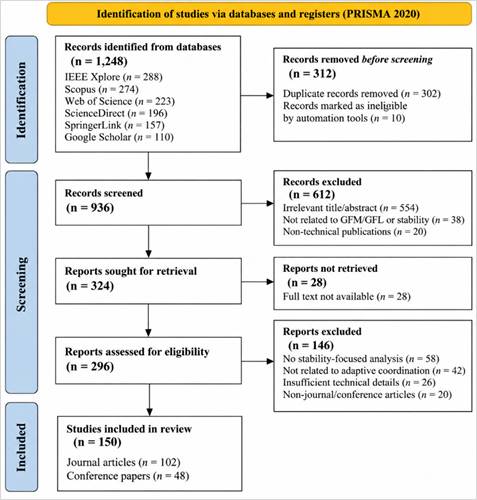
The literature search focused on research articles published in the last ten years (2015–2025), as grid-forming inverter technology, adaptive control strategies, and stability enhancement approaches have developed in renewable-rich distribution networks. This timeframe reflects recent developments following the rising penetration of inverter-based renewable energy resources and the shift toward converter-dominated power systems (Figure 1).

2.2 Review Questions Formulation

The review questions were designed to systematically investigate the existing research field on stability-oriented adaptive coordination of grid-forming and grid-following inverters. The questions aimed to identify current coordination strategies, stability enhancement goals, control methods, validation methods, and open issues. We designed a question structure to facilitate evidence mapping and provide a thorough overview of research trends, gaps, and prospects in renewable-rich distribution networks.

2.3 Search Strategy and Databases

We conducted a thorough literature search to identify related work on coordinating grid-forming and grid-following inverters, adaptive control, and stability improvement in distribution networks with high renewable penetration. We used combinations of related keywords and Boolean operators to develop the search strategy. To maximize coverage of engineering and energy research literature, we selected multiple academic databases (Table 1). The search process entailed title, abstract, and keyword screening to ensure the studies matched the review objectives.

2.4 Inclusion and Exclusion Criteria

To systematically select relevant studies for the scoping review, we established inclusion and exclusion criteria. We considered studies published from 2015 to 2025 in English that involved grid-forming and grid-following inverter coordination, adaptive control strategies, or stability enhancement in renewable-rich distribution networks. We accepted analytical, simulation, or experimental validation in peer-reviewed journal articles and conference papers. We excluded studies that did not pertain to any inverter-based system, non-technical publications, duplicate records, and papers without a stability-focused analysis.

2.5 Study Selection Process

We followed a methodical, transparent procedure to identify relevant literature in line with the PRISMA-ScR. First, we screened titles and abstracts from selected databases to remove irrelevant studies and duplicates. We then evaluated the remaining articles in full text using pre-established inclusion and exclusion criteria. Finally, we identified and extracted relevant studies for classification and evidence mapping to answer the review question.

2.6 Data Extraction and Charting Process

A structured data extraction and charting process was designed to systematically gather relevant data from the selected studies. The information retrieved included publication details, research goals, inverter types, coordination strategies, stability problems, control methods, validation procedures, and conclusions. The information gathered was structured into thematic categories to identify research trends, compare different approaches, and map gaps in knowledge on stability-oriented adaptive coordination of grid-forming and grid-following inverters.

2.7 Evidence Classification and Mapping Approach

The evidence classification and mapping approach categorized and combined data from the included studies by research theme. We extracted and classified evidence by inverter type, coordination strategy, stability objectives, control technique, modeling approach, and validation method. Thematic mapping highlighted dominant research trends, methodological developments, and gaps in the literature. This method allowed for detailed information on the state of the art and future research opportunities in adaptive GFM–GFL inverter coordination.

3. Overview of Included Studies

3.1 Publication Trends and Research Evolution

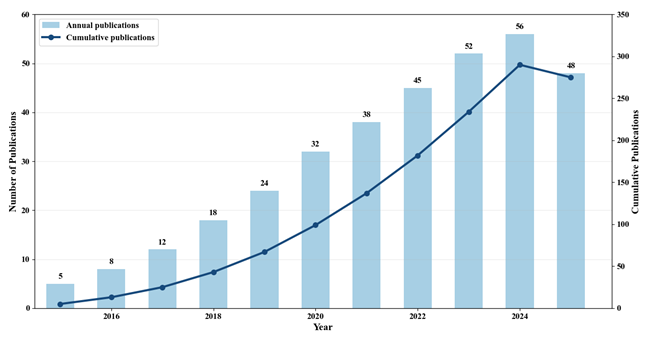
As shown in Figure 2, research activity in GFM–GFL inverter coordination has gradually increased from 2015 to 2025, as indicated by the trend analysis of GFM–GFL inverter coordination publications. The number of publications grew from 5 studies in 2015 to 56 studies in 2024, showing that researchers' interest in inverter-based renewable integration and stability issues is increasing. By

Figure 1. PRISMA 2020 flow diagram illustrating the study identification, screening, eligibility assessment, and inclusion process for the scoping review of stability-oriented adaptive coordination between grid-forming and grid-following inverters.

Table 1. Search Strategy and Databases Used for the Scoping Review.

IEEE Xplore

("Grid-forming inverter" OR "GFM") AND ("Grid-following inverter" OR "GFL") AND ("adaptive coordination" OR "coordinated control") AND ("stability")

Scopus

("inverter-based resources" OR "converter dominated grid") AND ("adaptive control" OR "stability enhancement") AND ("renewable distribution network")

Web of Science

("grid-forming control" OR "virtual synchronous generator") AND ("grid-following control") AND ("renewable energy integration")

ScienceDirect

("GFM inverter" AND "GFL inverter") AND ("frequency stability" OR "voltage stability" OR "oscillation mitigation")

SpringerLink

("adaptive inverter control") AND ("distributed coordination") AND ("power system stability")

Google Scholar

Combination of above keywords with citation tracking

2025, there were around 330 publications, indicating continued growth in this research field. Early investigations mainly studied GFL limitations, PLL problems, and grid failures during operation. Meanwhile, recent work has increasingly focused on GFM control methods, adaptive coordination, and approaches to enhance grid stability. This points to a shift from studies of individual inverters to coordinated solutions in renewable-dominated distribution networks.

3.2 Geographical Distribution of Research

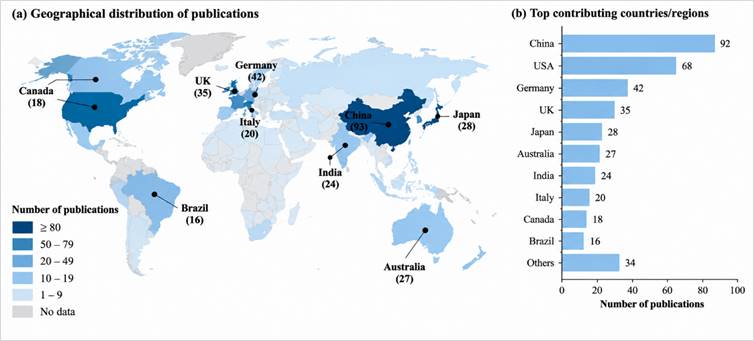
Geographical distribution analysis shows that work on GFM–GFL inverter coordination is widely spread across regions, with more focused efforts in areas where renewable energy implementation and power system modernization are gaining momentum. As shown in Figure 3, the USA and China contribute the most, with 68 and 93 identified studies, respectively. Research interest is also high in Europe (42% in Germany, 35% in the UK). Other regions, such as Japan (28), Australia (27), and India (24), also develop inverter control and stability solutions. The distribution shows broad global interest, with research still focused on countries with mature renewable energy deployment and grid transformation programs.

3.3 Research Methods and Validation Platforms

The literature reviewed shows that studies on GFM–GFL inverter coordination management are based on simulation and analytical methods. Researchers usually assess stability characteristics, oscillatory behavior, and converter-grid interactions using state-space measurements, small-signal analysis, and impedance measurements (Table 2). Researchers often use time-domain simulations in MATLAB/Simulink, PSCAD, and DIgSILENT PowerFactory to evaluate performance under various operating conditions. Recent research has added optimization and AI-inspired approaches to enhance adaptive control capability. However, hardware-in-the-loop and experimental validations remain comparatively limited, and gaps persist between theoretical developments and the practical implementation of coordinated inverter control strategies.

4. Conceptual Mapping of GFM and GFL Inverter Coordination

4.1 Grid-Following Inverter-Based Control Approaches

The reviewed studies suggest that grid-following inverter control remains a common method for integrating renewable energy because of its well-developed system and strong power-tracking performance (Table 3). However, because grid synchronization is generally based on conventional PLLs, weak-grid conditions can cause synchronization and stability issues that affect performance. To overcome these limitations, recent research has focused on developing improved PLL techniques, adaptive control techniques, and impedance-based improvements. While advanced GFL strategies offer better robustness and stability, they still rely on a grid voltage reference, a basic constraint that has motivated the development of coordinated GFM–GFL control strategies.

4.2 Grid-Forming Inverter-Based Control Approaches

The evaluated research shows that grid-forming inverter control methods have evolved from traditional droop-based control to more sophisticated virtual inertia, oscillator-based, and adaptive control methods. Although droop control is simple and decentralized for power sharing, it remains widely used, and VSG-based control is often explored to emulate inertia and support frequency. Other alternatives (VOC and matching control) offer better synchronization and less reliance on PLLs (Table 4). Recent research increasingly focuses on adaptive GFM control to improve robustness under different grid operating conditions. However, some issues remain: parameter tuning, computational complexity, and large-scale experiments of sophisticated GFM strategies.

5. Stability-Oriented Applications of Adaptive Coordination

5.1 Frequency Stability Enhancement

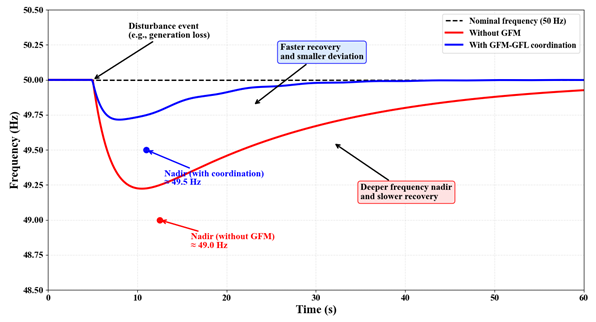
As shown in the conceptual frequency response comparison, coordinated GFM–GFL inverter operation can leverage this during grid disturbances. Conventional GFL-dominated operation shows higher frequency deviation, as shown in Figure 4, with a lower frequency bottom of around 49.0Hz and a slow recovery to the nominal frequency. Coordinated GFM–GFL operation, by contrast, provides faster frequency support and reduces the frequency drop, resulting in a minimum frequency of around 49.5 Hz. This improvement is due to GFM capabilities such as virtual inertia and fast frequency response, together with GFL active power control. Depending on system parameters, inverter capacity, and

Figure 2. Annual publication trend and cumulative research growth on stability-oriented adaptive coordination of grid-forming and grid-following inverters, illustrating the evolution of research interest from conventional inverter control to coordinated stability enhancement approaches during 2015–2025.

Figure 3. Geographical distribution of research on GFM–GFL inverter coordination studies, showing global publication density by country/region and the contribution of leading countries based on the number of included studies.

Table 2. Research Methods and Validation Platforms Reported in GFM–GFL Inverter.

Study Category

System/Modeling Approach

Validation Platform

Main Evaluation Objectives

Study

Analytical Studies

Linearized inverter and grid models

Theoretical analysis

Controller stability, dynamic characteristics, parameter influence

(Hakam & Tabaa, 2026)

Small-Signal Stability Studies

State-space models of GFM/GFL inverter systems

MATLAB/Simulink, PSCAD

Oscillation modes, damping improvement, stability margins

(Bhukya, 2026)

Impedance-Based Studies

Converter-grid interaction models

MATLAB/Simulink, PSCAD

Harmonic stability, resonance identification, weak-grid interaction

(Jeyaraj et al., 2020)

Time-Domain Simulation Studies

Detailed inverter and distribution network models

MATLAB/Simulink, PSCAD, DIgSILENT PowerFactory

Frequency response, voltage regulation, transient performance

(Jain et al., 2020)

Optimization-Based Studies

Control parameter optimization framework

MATLAB, Python-based optimization tools

Gain tuning, power sharing, stability enhancement

(Addai & Musilek, 2026)

AI/Data-Driven Studies

Data-driven inverter control models

MATLAB, Python, simulation environments

Adaptive operation under uncertainty

(Rostami et al., 2026)

Hardware-in-the-Loop Studies

Real-time digital simulation models

OPAL-RT, Typhoon HIL, dSPACE

Controller feasibility and real-time performance

(Addai & Musilek, 2026)

Experimental Studies

Physical inverter-based test systems

Laboratory-scale microgrid/inverter setup

Practical validation and controller performance

(Ozkurt et al., 2026)

Table 3. Classification and Critical Analysis of Grid-Following Inverter-Based Control Approaches.

GFL Control Approach

Control Principle

Key Components/Techniques

Stability Aspect Addressed

Main Advantages

Key Limitations

Study

Conventional PLL-Based GFL Control

Synchronizes inverter output with grid voltage angle using PLL

Phase-locked loop (PLL), current control, PWM modulation

Grid synchronization and power tracking

Simple structure, widely adopted in renewable energy systems

Performance degradation under weak-grid conditions due to PLL interaction

(Khan et al., 2024)

Enhanced PLL-Based Control

Improves synchronization dynamics and reduces PLL-related instability

Adaptive PLL, decoupled PLL, filtered PLL

Small-signal stability and oscillation reduction

Improved dynamic response under grid disturbances

Additional control complexity and parameter tuning requirements

(Liu et al., 2025)

Current-Controlled GFL Approach

Regulates inverter current based on grid reference signals

Inner current loop, outer power control loop, DC-link control

Active/reactive power regulation

Fast response and mature implementation

Requires reliable grid voltage reference

(Wang et al., 2026)

Voltage-Supportive GFL Control

Provides limited voltage regulation through reactive power control

Q–V control, voltage compensation, virtual impedance

Voltage stability enhancement

Improves voltage profile in distribution networks

Limited capability for independent grid support

(Xiaoyu et al., 2026)

Weak-Grid Adaptive GFL Control

Adjusts control parameters according to grid strength variations

Adaptive PLL, robust control, impedance shaping

Weak-grid stability and converter-grid interaction

Improved robustness under low SCR conditions

Higher computational and design complexity

(Liao et al., 2026)

Advanced Intelligent GFL Control

Uses optimization and data-driven methods for adaptive operation

MPC, machine learning, AI-based tuning

Stability under uncertainty and variable operating conditions

Enhanced adaptability and predictive capability

Limited practical validation and higher implementation requirements

(Hollweg et al., 2025)

Table 4. Classification and Comparative Analysis of Grid-Forming Inverter-Based Control Approaches.

GFM Control Method

Basic Principle

Key Control Elements

Typical Parameter Values

Study

Droop Control

Mimics synchronous generator characteristics through power-frequency and voltage-reactive power relationship

P–f and Q–V droop controllers

Frequency droop: 2–5%; Voltage droop: 1–5%

(Waskito et al., 2025)

Virtual Synchronous Generator (VSG)

Emulates synchronous generator dynamics using virtual inertia and damping

Swing equation, virtual inertia, damping coefficient

Virtual inertia: 1–10 s; Damping coefficient: system dependent

(Gurski et al., 2024)

Virtual Oscillator Control (VOC)

Generates self-synchronized voltage waveform using nonlinear oscillator dynamics

Virtual oscillator, amplitude and frequency regulation

Oscillator gain: design dependent; Response time: ms-level

(Suvorov et al., 2023)

Matching Control

Links converter dynamics with synchronous machine behavior

DC-link voltage–frequency coupling

DC voltage reference: system dependent; PLL-free operation

(Alshahrani et al., 2024)

Dispatchable VOC (dVOC)

Combines oscillator-based synchronization with active power dispatch

Nonlinear oscillator and power control loop

Power tracking error: system dependent

(Dolado et al., 2022)

Adaptive GFM Control

Dynamically adjusts control parameters based on operating conditions

Adaptive droop, variable virtual inertia, optimization-based tuning

Adaptive gain variation: operating-point dependent

(Alshahrani et al., 2024)

Figure 4. Conceptual frequency response comparison illustrating the impact of coordinated GFM–GFL inverter operation following a grid disturbance, highlighting reduced frequency deviation, improved frequency nadir, and faster recovery compared with conventional GFL-dominated operation.

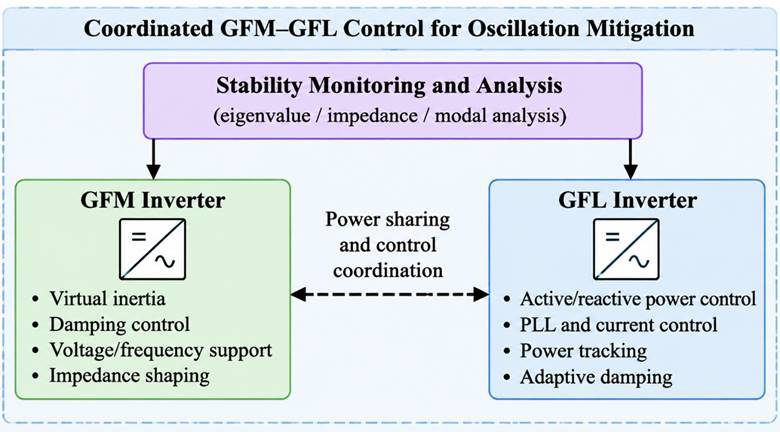
Figure 5. Conceptual framework illustrating small-signal stability enhancement and oscillation mitigation through coordinated GFM–GFL inverter control, integrating stability monitoring, inverter-specific control functions, and power-sharing coordination for improved damping performance.

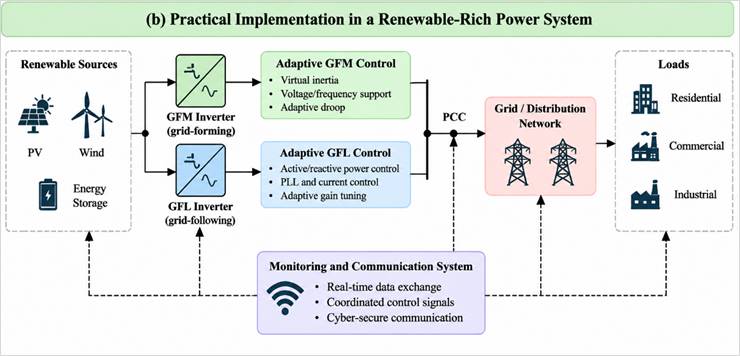
Figure 6. Practical implementation framework of adaptive GFM–GFL coordination techniques in renewable-rich power systems, illustrating renewable sources, adaptive inverter controls, grid interaction through the point of common coupling (PCC), and monitoring-based coordinated operation.

operating conditions, actual performance varies accordingly.

5.2 Small-Signal Stability and Oscillation Mitigation

Small-signal stability analysis is key to characterizing dynamic interactions between inverter-based resources and detecting oscillatory phenomena in distribution grids with a higher share of renewables. The studies reviewed typically use eigenvalue analysis, impedance analysis, and modal analysis techniques to study converter-grid interactions and damping. Based on the coordinated GFM–GFL control frameworks illustrated in Figure 5, GFM inverters stabilize the network and augment GFL inverter control functions by providing virtual inertia, damping support, and impedance shaping. This coordination can improve oscillation damping, reduce interaction-induced instability, and increase stability margins. However, these methods depend on accurate system modeling, parameter tuning, and model validation under various operating conditions.

6. Mapping of Adaptive Coordination Techniques

Adaptive coordination techniques are an emerging research field that aims to coordinate the dynamic interaction between grid-forming (GFM) and grid-following (GFL) inverters in distribution systems with high penetration of renewable energy sources. The implemented studies show that adaptive frameworks typically combine real-time monitoring, operating-condition evaluation, and coordinated control adjustments to enhance system stability. Adaptive decision-making inputs include renewable sources, energy storage systems, and grid conditions, as shown in Figure 6. The GFM inverter provides voltage/frequency regulation via virtual inertia and adaptive droop control. In contrast, the GFL inverter provides active/reactive power regulation and power tracking. The monitoring and communication layer enables information exchange and coordinated parameter updates. These frameworks offer greater flexibility, stability, and resilience under variable renewable generation and changing grid conditions. However, communication needs, computational burden, and operational feasibility in large-scale distribution networks remain issues.

7. Discussion

This scoping review provides a structured overview of the evolution, methodological development, and stability-oriented applications of adaptive coordination between grid-forming (GFM) and grid-following (GFL) inverters in renewable-rich distribution networks. The results show that research interest in GFM–GFL coordination has grown considerably from 2015 to 2025, driven by the growing significance of inverter-based resources and the need to sustain stable operation in a converter-dominated power system. The shift from conventional inverter studies to a coordinated and adaptive approach reflects a broader research focus shift from individual inverter performance to improved system stability.

The analyzed studies show that GFL inverters remain widely used because of their well-developed control architecture for renewable energy integration and maximum power extraction. However, relying on grid voltage synchronization via PLLs (phase-locked loops) can cause stability issues in weak grids. Several studies have shown that interactions between PLL dynamics and converter control loops, as well as interactions with grid impedances, affect small-signal stability and robustness in low short-circuit ratio (SCR) scenarios (Md Shahdat Hossain & Md Atiqur Rahman, 2022; Md. M. Rahman & Mohamed, 2023; Xiong & Luo, 2025). To improve GFL performance under challenging grid conditions, recent research has focused on improved PLL structures, impedance-based analysis, and adaptive control methods. However, GFL systems rely on an external voltage reference, which limits the autonomy available for grid-supporting functions.

In contrast, GFM inverter technology has received more attention because it can set voltage and frequency references without relying on an external grid signal. The literature reviewed in this study shows that the most dominant research directions are droop control, virtual synchronous generator (VSG), virtual oscillator control (VOC), and adaptive GFM methods. Droop-based approaches offer decentralized power sharing with relatively simple implementation, whereas VSG-based methods add virtual inertia and damping properties similar to synchronous machines (Md Shahdat Hossain & Md Atiqur Rahman, 2024; Sati et al., 2025; Waskito et al., 2025). GFM controls have been shown to enhance frequency response and provide grid-support functions in low-inertia systems (Babu et al., 2024; Khan et al., 2024; Md Arman Hossain et al., 2021). Issues remain in parameter selection, dynamic interactions, protection coordination, and validation when deployed at large scale.

This review also shows that frequency stability is the most studied objective in GFM–GFL coordination research. Reduced synchronous inertia in networks with high renewable penetration is linked to growing interest in virtual inertia and fast frequency response strategies. GFM inverters can provide fast frequency support via controlled active power response, and GFL inverters can complement this through their power-regulation capabilities (Howlader et al., 2026; Moore et al., 2025; Waskito et al., 2025). However, the effectiveness of such coordination depends on inverter ratings, available energy, control parameters, and grid operating conditions. Thus, frequency improvements reported in individual studies should be interpreted as improvements in that particular system configuration, not as improvements in frequency in general.

Another significant research area in the reviewed literature is voltage stability. With intermittent generation in renewable-rich distribution networks and reduced conventional voltage support, voltage variability increases. Previous research has focused on reactive power control, voltage–reactive power droop strategies, and virtual impedance approaches to enhance voltage regulation and mitigate converter interaction issues (Adiche et al., 2024; Dou et al., 2017; Lyu et al., 2018). GFM inverters add flexibility through their voltage-forming capability, while GFL inverters control active and reactive power exchange. However, practical implementation must account for inverter limitations, network parameters, and coordination needs.

The review also highlights that a small-signal stability assessment is a key element when assessing GFM–GFL interactions. Oscillatory behavior and converter-grid interactions are often analyzed using eigenvalue analysis, impedance-based methods, and modal analysis. Because it offers a systematic way to consider interactions between converter dynamics and grid characteristics, impedance-based stability analysis has gained particular relevance (Farabi Hasan Chadni & Md Shahdat Hossain, 2023; Md. M. Rahman & Mohamed, 2023; Sati et al., 2025; Xiong & Luo, 2025). However, many current studies rely on simplified models and simulation-only validation, which may not fully capture complex distribution networks and diverse inverter technologies.

This review identifies one research gap: the lack of experimental and hardware validation. Real-time and lab-scale validation is much less common than simulation platforms like MATLAB/Simulink, PSCAD, or DIgSILENT PowerFactory. The literature has noted the need for practical demonstrations and standardized testing procedures before the widespread use of advanced GFM coordination strategies (Arévalo et al., 2025; A. Hossain et al., 2025; Md. A. Rahman et al., 2026; Richter et al., 2025). In addition, distributed adaptive coordination also faces problems such as communication delay, cybersecurity, and scalability.

In recent years, researchers have studied artificial intelligence, optimization methods, and data-oriented methods to enhance adaptive inverter coordination. These techniques offer options for online parameter tuning and better decision-making amid uncertainties in renewable generation. In practice, however, their use also needs to be explored from a computational perspective, including data dependency, interpretability, and real-time implement ability. Thus, future studies should focus on creating adaptive frameworks that incorporate intelligent control and powerful architectures with low computational demands.

Overall, the evidence synthesized in this scoping review suggests that coordinated operation of GFM–GFL inverters is a promising strategy for improving stability in a distribution network with a high percentage of renewable energy. Current studies, however, still face validity gaps, a lack of standardized benchmarking, and implementation challenges at scale. Future investigations are expected to focus on experimental tests and validations of scalable, resilient coordination frameworks that can maintain reliable operation in more converter-dominated power systems.

8. Conclusion

This scoping review provides an extensive overview of stability-oriented adaptive coordination of grid-forming inverters (GFI) and grid-following inverters (GFI) in distribution networks with high renewable energy penetration. The results show a clear shift from classic inverter control to coordinated solutions to address frequency, voltage, and small-signal stability problems. However, technologies like droop control and VSG, along with adaptive technologies, are promising for increasing grid-support services, and GFL technologies are critical for power regulation and renewable integration. However, most studies rely on simulation-based validation, with few experimental demonstrations and evaluation frameworks. Further research is needed to develop scalable, robust, and practically proven adaptive coordination strategies to support reliable operation of increasingly inverter-dominated distribution networks.

Author Contributions

Prashanta Chakraborty conceived and designed the study, conducted the literature search and screening, extracted and analyzed the data, and performed the evidence synthesis. The author drafted the manuscript, critically revised it for important intellectual content, and approved the final version for submission.

References


Addai, M., & Musilek, P. (2026). Artificial Intelligence-Enhanced Droop Control for Renewable Energy-Based Microgrids: A Comprehensive Review. Electronics, 15(3), 707. https://doi.org/10.3390/electronics15030707

Adiche, S., Larbi, M., Toumi, D., Bouddou, R., Bajaj, M., Bouchikhi, N., Belabbes, A., & Zaitsev, I. (2024). Advanced control strategy for AC microgrids: a hybrid ANN-based adaptive PI controller with droop control and virtual impedance technique. Scientific Reports, 14(1), 31057. https://doi.org/10.1038/s41598-024-82193-1

Alshahrani, S., Khan, K., Abido, M., & Khalid, M. (2024). Grid-Forming Converter and Stability Aspects of Renewable-Based Low-Inertia Power Networks: Modern Trends and Challenges. Arabian Journal for Science and Engineering, 49(5), 6187–6216. https://doi.org/10.1007/s13369-023-08399-z

Arévalo, P., Ramos, C., & Rocha, A. (2025). A Systematic Review of Grid-Forming Control Techniques for Modern Power Systems and Microgrids. Energies, 18(14), 3888. https://doi.org/10.3390/en18143888

Babu, V. V., Roselyn, J. P., Nithya, C., & Sundaravadivel, P. (2024). Development of Grid-Forming and Grid-Following Inverter Control in Microgrid Network Ensuring Grid Stability and Frequency Response. Electronics, 13(10), 1958. https://doi.org/10.3390/electronics13101958

Bhukya, J. (2026). Damping controller implementation for sub-synchronous resonance mitigation in DFIG systems using real-time simulation. Electrical Engineering, 108(2), 114. https://doi.org/10.1007/s00202-025-03469-x

Dolado, J., Rodríguez Amenedo, J. L., Arnaltes, S., & Eloy-Garcia, J. (2022). Improving the Inertial Response of a Grid-Forming Voltage Source Converter. Electronics, 11(15), 2303. https://doi.org/10.3390/electronics11152303

Dou, C., Zhang, Z., Yue, D., & Song, M. (2017). Improved droop control based on virtual impedance and virtual power source in low-voltage microgrid. IET Generation, Transmission & Distribution, 11(4), 1046–1054. https://doi.org/10.1049/iet-gtd.2016.1492

Farabi Hasan Chadni, & Md Shahdat Hossain. (2023). Advanced Fault Analysis and Protection Strategies for Distribution Grids with High Renewable Energy Penetration. International Journal on Orange Technologies, 8(5), 139–148.

Gurski, E., Kuiava, R., Perez, F., Benedito, R. A. S., & Damm, G. (2024). A Novel VSG with Adaptive Virtual Inertia and Adaptive Damping Coefficient to Improve Transient Frequency Response of Microgrids. Energies, 17(17), 4370. https://doi.org/10.3390/en17174370

Hakam, Y., & Tabaa, M. (2026). Grid-Forming Inverters in Photovoltaic Power Systems: A Comprehensive Review of Modeling, Control, and Stability Perspectives. Energies, 19(5), 1244. https://doi.org/10.3390/en19051244

Hollweg, G. V., Singh Chawda, G., Chaturvedi, S., Bui, V.-H., & Su, W. (2025). Optimization Techniques for Low-Level Control of DC–AC Converters in Renewable-Integrated Microgrids: A Brief Review. Energies, 18(6), 1429. https://doi.org/10.3390/en18061429

Hossain, A., Oyebode, D., Imon, K. A. Al, Faisal, S. Md. W., & Vayyala, R. (2025). Analyzing how MIS can optimize the distribution of energy in smart grids, focusing on data-driven decision-making processes. Journal of Smart Internet of Things, 2025(1), 31–42. https://doi.org/10.2478/jsiot-2025-0004

Hossain, M. A. (2025). Residual Stress Mitigation and Distortion Control in Laser Powder Bed Fusion Components for High-Reliability Engineering Applications. American Journal of Advanced Technology and Engineering Solutions, 01(02), 173–215. https://doi.org/10.63125/1b3nyj37

Howlader, Md. N., Chowdhury, S., Al Imon, K. A., Khan, G. J., Mehedi, Md. K. H., Rabbi, Md. F., Islam, A., & Al Zami Alif, S. (2026). Design and implementation of a low-cost IoT-enabled dual-axis photovoltaic tracking system with experimental and simulation-based validation. Journal of Electrical Systems and Information Technology, 13(1), 44. https://doi.org/10.1186/s43067-026-00351-z

Huang, L., Xin, H., Dong, W., & Dörfler, F. (2022). Impacts of Grid Structure on PLL-Synchronization Stability of Converter-Integrated Power Systems. IFAC-PapersOnLine, 55(13), 264–269. https://doi.org/10.1016/j.ifacol.2022.07.270

Jain, H., Bhatti, B. A., Wu, T., Mather, B., & Broadwater, R. (2020). Integrated Transmission-and-Distribution System Modeling of Power Systems: State-of-the-Art and Future Research Directions. Energies, 14(1), 12. https://doi.org/10.3390/en14010012

Jeyaraj, K., Durairaj, D., & Velusamy, A. I. S. (2020). Development and performance analysis of PSO-optimized sliding mode controller–based dynamic voltage restorer for power quality enhancement. International Transactions on Electrical Energy Systems, 30(3). https://doi.org/10.1002/2050-7038.12243

Kazi Abdullah Al Imon, Abdullah Al Hossain Newaz, & Nasir Uddin, I. K. T. (2022). Electromechanical Integration for Hybrid Solar and Wind Energy Systems: A Case for Maximized Renewable Energy Capture. Revista de Gestão Social e Ambiental, 16(3), 1–37.

Khan, M., Wu, W., & Li, L. (2024). Grid-forming control for inverter-based resources in power systems: A review on its operation, system stability, and prospective. IET Renewable Power Generation, 18(6), 887–907. https://doi.org/10.1049/rpg2.12991

Liao, Z., Hu, Q., Huang, Z., Ge, J., Yang, D., & Ma, X. (2026). A Seamless Transition Control Strategy Based on Adaptive Fusion Between Grid-Following and Grid-Forming Inverters for Wide-Ranging Grid-Strength Fluctuations. Electronics, 15(6), 1298. https://doi.org/10.3390/electronics15061298

Liu, Y., Zhu, L., Xu, X., Li, D., Liang, Z., & Ye, N. (2025). Transient Synchronization Stability in Grid-Following Converters: Mechanistic Insights and Technological Prospects—A Review. Energies, 18(8), 1975. https://doi.org/10.3390/en18081975

Lyu, Z., Wei, Q., Zhang, Y., Zhao, J., & Manla, E. (2018). Adaptive Virtual Impedance Droop Control Based on Consensus Control of Reactive Current. Energies, 11(7), 1801. https://doi.org/10.3390/en11071801

Ma, R., Cheng, Y., Wang, S., Sun, S., & Cong, W. (2026). Generalized Dynamic Security Region of Grid-Following and Grid-Forming Converter-Based Systems by Basin of Attraction Method. Applied Sciences, 16(4), 2130. https://doi.org/10.3390/app16042130

Matevosyan, J., Halley, A., Ramasubramanian, D., Shattuck, A., Macdowell, J. M., Senthil, J., Acosta, M. C., Isaacs, A., Badrzadeh, B., Zhang, Q., Maleki, H., & Samarasekera, K. (2024). Considerations, Challenges and Evolution in Dynamic Modeling of Synchronous Machines and Inverter-Based Resources (pp. 351–435). https://doi.org/10.1007/978-3-031-47821-5_8

Md Arman Hossain, Md Abdul Aziz Bhuiyan, Atiqur Rahman, & Dewan Wardy Hasan. (2024). Integration of Artificial Intelligence for Real-Time Monitoring and Process Control in Metal Additive Manufacturing Systems. Journal of Mechanical, Civil and Industrial Engineering, 5(3), 08–28. https://doi.org/10.32996/jmcie.2024.5.3.2

Md Arman Hossain, Shipon Chandra Barman, Wei Pi, & S M Tarikul Islam. (2022). A Study on Hybrid Manufacturing Systems Integrating Additive Manufacturing and CNC Machining for High-Precision Industrial Component Production. Journal of Mechanical, Civil and Industrial Engineering, 3(2), 24–41. https://doi.org/10.32996/jmcie.2022.3.2.4

Md Arman Hossain, Wei Pi, S M Tarikul Islam, & Mohaiminul Islam Lide. (2021). Smart Manufacturing Framework for Real-Time Process Monitoring, Predictive Maintenance, and Quality Control in Advanced Mechanical Production Systems. Journal of Mechanical, Civil and Industrial Engineering, 2(1), 11–24. https://doi.org/10.32996/jmcie.2021.2.1.3

Md Shahdat Hossain, & Md Atiqur Rahman. (2022). Integration of Solar Thermal Energy and Solar Electricity Generation for Sustainable Power Production. Central Asian Journal of Theoretical and Applied Science, 3(5), 415–424.

Md Shahdat Hossain, & Md Atiqur Rahman. (2024). Optimization of Series and Shunt Capacitor Compensation for Power Factor Improvement in Electrical Power Systems. American Journal of Engineering, Mechanics and Architecture, 2(3), 220–228.

Minchala-Ávila, C., Arévalo, P., & Ochoa-Correa, D. (2025). A Systematic Review of Model Predictive Control for Robust and Efficient Energy Management in Electric Vehicle Integration and V2G Applications. Modelling, 6(1), 20. https://doi.org/10.3390/modelling6010020

Moore, P., Alimi, O. A., & Abu-Siada, A. (2025). A Review of System Strength and Inertia in Renewable-Energy-Dominated Grids: Challenges, Sustainability, and Solutions. Challenges, 16(1), 12. https://doi.org/10.3390/challe16010012

Nurunnabi, M., & Li, S. (2026). Protection in Inverter-Dominated Grids: Fault Behavior of Grid-Following vs. Grid-Forming Inverters and Mixed Architectures—A Review. Energies, 19(3), 684. https://doi.org/10.3390/en19030684

Ozkurt, H., Sari, F., Taner, T., & Dalkilic, A. S. (2026). Optimization and OGY-based chaos control of a bistable piezoelectric energy harvester for enhanced power generation. Scientific Reports. https://doi.org/10.1038/s41598-026-63120-y

Qiao, Y., Li, W., & Guo, D. (2026). AI-enhanced model predictive control in microgrids: systematic review of algorithms, applications, and emerging trends. Journal of Power Electronics, 26(4), 831–842. https://doi.org/10.1007/s43236-026-01312-5

Rahman, Md. A., Prantik, M. F. R., Islam, S. M. T., Rahman, A., Masum, S. H., & Hossain, M. A. (2026). Hyperdimensional computing and ridge regression for airfoil aerodynamic prediction?: A physics-informed machine learning framework. Aerospace Science and Technology, 171, 111591. https://doi.org/10.1016/j.ast.2025.111591

Rahman, Md. M., & Mohamed, Y. A.-R. I. (2023). Interaction Dynamics and Active Suppression of Instability in Parallel Photovoltaic Voltage-and Current-Source Converters Connected to a Weak Grid. IEEE Open Journal of Power Electronics, 4, 395–414. https://doi.org/10.1109/OJPEL.2023.3275610

Richter, M., Kuri, A., Richter, J., Wagner, T., Henninger, S., & Mehlmann, G. (2025). Demonstration of Grid-Forming Controls in Hybrid AC/DC Grid in a Real-Time PHiL Environment. Electronics, 14(4), 730. https://doi.org/10.3390/electronics14040730

Rostami, M., Habibi, P., & Farajollahi, A. (2026). Fuzzy energy management using a chaotic model to improve fuel consumption of fuel cell-battery hybrid fixed-wing UAVs operating under uncertainty control. Scientific Reports, 16(1), 4196. https://doi.org/10.1038/s41598-025-34306-7

Sati, S. E., Abdelghany, M. B., Hamad, B., Al-Durra, A., Zeineldin, H. H., EL-Fouly, T. H. M., & El-Saadany, E. F. (2025). Economic Power-Sharing and Stability Enhancement for Virtual Synchronous Generators in Islanded MG. IEEE Transactions on Power Systems, 40(1), 188–203. https://doi.org/10.1109/TPWRS.2024.3413299

Suvorov, A., Askarov, A., Ruban, N., Rudnik, V., Radko, P., Achitaev, A., & Suslov, K. (2023). An Adaptive Inertia and Damping Control Strategy Based on Enhanced Virtual Synchronous Generator Model. Mathematics, 11(18), 3938. https://doi.org/10.3390/math11183938

Tasnia, R., & Hossain, M. S. (2026). Investment Barriers and Financing Solutions for Critical Energy Infrastructure Projects. Pacific Journal of Advanced Engineering Innovations, 3(1), 89–96. https://doi.org/10.70818/pjaei.v03i01.0246

Ullah, S. M. E., Ullah, M. S., & Hossain, M. S. (2025). Design and Implementation of Digital Protection Systems for High-Voltage Transmission Lines and Power Transformers. Journal of Knowledge Learning and Science Technology ISSN: 2959-6386 (Online), 4(4), 134–141. https://doi.org/10.60087/jklst.vol4.n4.015

Wang, X., Sun, K., Xu, Z., Li, M., Cao, G., & Li, K. (2026). A Systematic Review of Grid Following, Grid Forming and Mode Switching Control in MVDC Distribution Networks. IET Generation, Transmission & Distribution, 20(1). https://doi.org/10.1049/gtd2.70273

Waskito, F., Wijaya, F. D., & Firmansyah, E. (2025). Review of Virtual Inertia Based on Synchronous Generator Characteristic Emulation in Renewable Energy-Dominated Power Systems. Electricity, 6(4), 69. https://doi.org/10.3390/electricity6040069

Xiaoyu, P., Feng, L., Peng, Y., Beisi, T., Pengfei, G., & Zhaojian, W. (2026). Measuring Short-term Voltage Stability of Power Systems Dominated by Inverter-based Resources Part II: Port-wise Generalized Voltage Damping Index. Journal of Modern Power Systems and Clean Energy, 14(1), 82–94. https://doi.org/10.35833/MPCE.2024.001298

Xiong, X., & Luo, B. (2025). Impedance Reshaping Method Based on Compensating PLL Dynamic to Improve Active Power Transfer Capability of VSC Under Weak Grid. IEEE Transactions on Power Electronics, 40(1), 422–434. https://doi.org/10.1109/TPEL.2024.3459094

Article metrics
View details
0
Downloads
0
Citations
330
Views
📖 Cite article

View Dimensions


View Plumx


View Altmetric


0
Save
0
Citation
330
View
0
Share