4.1 Overview of the Main Findings
This study examined the major factors associated with insulation performance in high-voltage transmission and distribution systems, with particular attention to environmental contamination, partial discharge, insulation aging, moisture influence, mechanical stress, electrical overloading, preventive maintenance, and condition monitoring. Taken together, the findings suggest that insulation performance is not shaped by one dominant cause alone. Rather, it appears to be influenced by a cluster of environmental, electrical, material, and
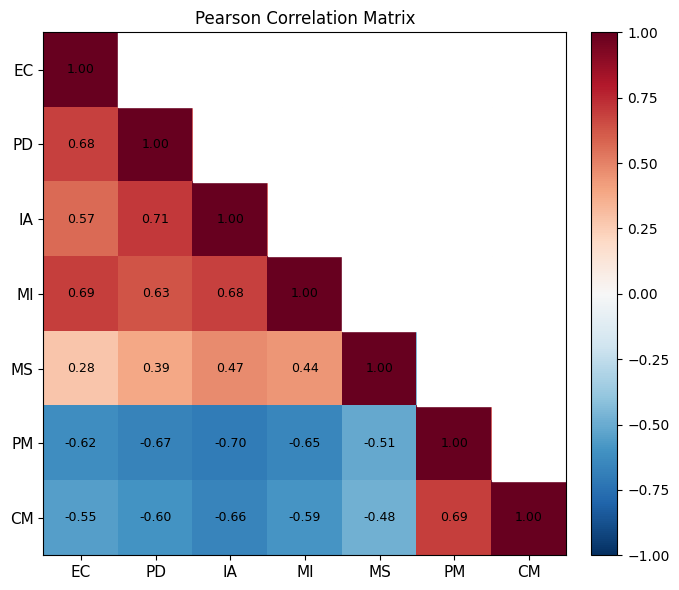
Figure 2. Pearson correlation matrix of insulation-related factors. This figure presents the correlation pattern among major degradation and improvement-related factors. Strong positive correlations were observed between partial discharge and insulation aging, as well as between environmental contamination and moisture influence. Preventive maintenance and condition monitoring showed negative correlations with several degradation factors, indicating their potential role in reducing insulation deterioration. Abbreviations: EC, environmental contamination; PD, partial discharge; IA, insulation aging; MI, moisture influence; MS, mechanical stress; PM, preventive maintenance; CM, condition monitoring. EC = Environmental Contamination; PD = Partial Discharge; IA = Insulation Aging; MI = Moisture Influence; MS = Mechanical Stress; PM = Preventive Maintenance; CM = Condition Monitoring.
maintenance-related conditions that interact gradually over time.
The respondent profile provides a useful basis for interpreting these findings. Electrical engineers formed the largest group of participants, followed by substation operators, maintenance technicians, and field supervisors [Table 1]. This mix is important because high-voltage insulation problems are not confined to design calculations or laboratory theory. They are often first noticed through inspection, operation, maintenance, and fault-response activities. The educational profile of the respondents also suggests that the dataset reflects both technical training and practical field exposure [Table 1]. In that sense, the results can be understood as a professional assessment of insulation-related risks in real operational settings, rather than as a purely theoretical evaluation.
4.2 Environmental Contamination as a Primary Operational Threat
Environmental contamination emerged as the highest-ranked factor affecting insulation performance, with a mean score of 4.40 [Table 2]. This result is technically reasonable and consistent with previous studies showing that outdoor high-voltage insulation is highly vulnerable to dust, salt, industrial pollutants, and other surface deposits (Hussain et al., 2017; Rafiq et al., 2020; Rahman et al., 2021). Under dry conditions, these contaminants may remain relatively inactive. However, when moisture, humidity, rainfall, or condensation is present, the contaminated layer can become conductive and increase leakage current. Over time, this may promote surface discharge, tracking, flashover, and accelerated insulation deterioration.
The strong correlation between environmental contamination and moisture influence further supports this interpretation [Figure 2]. In practical terms, contamination and moisture rarely behave as separate problems in the field. A polluted insulator surface becomes more dangerous when exposed to humidity, and a humid environment can intensify the effect of even moderate contamination. This finding is especially relevant for high-voltage systems located in coastal, industrial, desert, or densely populated urban regions, where airborne particles and moisture may act together. Previous risk-based studies have also emphasized the role of environmental pollution and weather exposure in high-voltage substation and outdoor insulator failure (Sierra et al., 2015; Hussain et al., 2017).
The implication is clear: utilities should not treat environmental contamination as a minor maintenance issue. Regular cleaning, pollution mapping, hydrophobic surface protection, and risk-based inspection scheduling may be necessary in regions where contamination levels are high. This becomes even more important when operating conditions include humidity or frequent rainfall.
4.3 Partial Discharge and Insulation Aging as Linked Degradation Processes
Partial discharge was ranked as the second most influential factor, with a mean score of 4.30 [Table 2]. The regression analysis also identified partial discharge as one of the strongest degradation-related predictors of insulation performance [Table 3]. This finding aligns with the established view that partial discharge is both a symptom and a driver of insulation deterioration. It may begin in small voids, defects, cracks, interfaces, or contaminated regions, but repeated discharge activity can progressively damage insulation material and reduce dielectric strength (Li & Li, 2017; Su et al., 2020).
The strongest positive correlation in the study was observed between partial discharge and insulation aging [Figure 2]. This relationship deserves careful attention. It suggests that insulation aging and partial discharge may reinforce one another in a progressive deterioration cycle. Aging weakens the material, increases defect formation, and reduces resistance to electrical stress. Partial discharge then exploits these weaknesses and may accelerate further degradation. In high-voltage systems, this type of gradual deterioration is particularly problematic because early-stage damage may not be visible during routine inspection.
Insulation aging also showed a high mean score of 4.20 [Table 2], confirming that respondents viewed long-term material degradation as a major concern. This result is consistent with studies showing that electrical, thermal, chemical, and environmental stresses gradually alter the physical and dielectric properties of insulation materials (Taghvaei et al., 2020; Zhou et al., 2017). The finding reinforces the need for maintenance programs that do not rely only on visible damage or emergency failure response. Instead, utilities may need periodic diagnostic testing, partial discharge measurement, thermal inspection, and insulation health-index evaluation to identify deterioration before it becomes irreversible.
4.4 Moisture, Mechanical Stress, and Electrical Overloading
Moisture influence ranked fourth among the assessed factors, with a mean score of 4.10 [Table 2]. Although it did not rank above environmental contamination, partial discharge, or aging, its contribution should not be underestimated. Moisture can reduce surface resistance, support contaminant conductivity, and affect dielectric behavior in insulation systems. Its positive relationship with environmental contamination and partial discharge suggests that moisture may function as an amplifying factor rather than an isolated cause [Figure 2]. This is particularly important for outdoor insulators, transformer insulation, and equipment exposed to seasonal humidity variation.
Mechanical stress and electrical overloading received somewhat lower mean scores than the other factors, but they still remained relevant [Table 2]. Mechanical stress may occur due to vibration, seismic movement, installation errors, wind load, thermal expansion, or structural deformation. Previous studies have shown that mechanical and seismic stresses can influence the reliability of high-voltage insulators and related equipment (Gökçe et al., 2018; Günay & Mosalam, 2013; Mosalam & Günay, 2013). In the present regression analysis, however, mechanical stress was not statistically significant at the 0.05 level [Table 3]. This may indicate that, within this dataset, mechanical stress had a weaker independent influence when environmental, electrical, and maintenance-related factors were considered together.
Electrical overloading also showed a moderate mean score [Table 2]. While it was not emphasized as strongly as contamination or partial discharge, it remains technically important because repeated overloading, transient voltage events, and switching stresses can contribute to progressive insulation deterioration. These findings suggest that overload-related risk may become more visible when combined with aging materials, environmental stress, or existing insulation defects.
4.5 Preventive Maintenance as the Dominant Protective Strategy
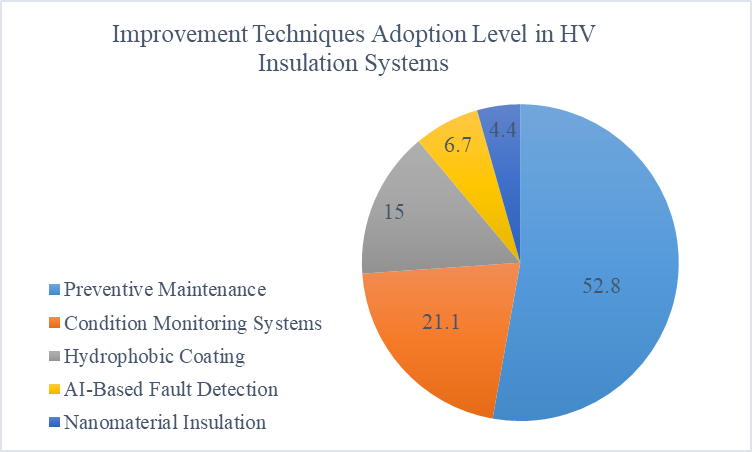
Preventive maintenance was the most widely adopted improvement technique, reported by 52.8% of respondents [Figure 1]. It also showed strong negative correlations with insulation aging and partial discharge [Figure 2], and regression analysis indicated a significant protective association with insulation performance [Table 3]. These findings strongly suggest that preventive maintenance remains central to insulation reliability management.
This is not surprising. Preventive maintenance is practical, familiar, and relatively affordable compared with advanced monitoring or AI-based diagnostic systems. Routine inspection, cleaning, tightening, testing, and replacement can reduce the accumulation of risk before it develops into failure. Previous work on high-voltage equipment performance has similarly emphasized the role of systematic maintenance and reliability-focused inspection in reducing operational vulnerability (Mosalam & Günay, 2013; Zhou et al., 2017).
Still, the findings also suggest a possible limitation. While preventive maintenance is valuable, it may not always detect early internal deterioration, especially partial discharge or hidden material defects. Therefore, preventive maintenance should not be viewed as a complete solution by itself. A more effective strategy may be to combine traditional maintenance with condition monitoring, targeted diagnostics, and risk-based asset management.
4.6 Emerging Role of Condition Monitoring and Advanced Technologies
Condition monitoring was adopted by 21.1% of respondents [Figure 1]. Although this adoption rate was much lower than preventive maintenance, the statistical findings suggest that condition monitoring has meaningful value. It showed negative associations with several degradation factors [Figure 2] and a significant protective coefficient in the regression model [Table 3]. This indicates that monitoring systems may help reduce insulation risk by detecting early-stage faults before they become severe.
This finding is consistent with previous studies describing the usefulness of electrical diagnostic techniques, optical sensors, infrared thermography, and partial discharge monitoring for assessing high-voltage equipment condition (Fofana & Hadjadj, 2016; Li & Li, 2017; Ma et al., 2020). In practice, condition monitoring allows utilities to move from time-based maintenance toward condition-based or predictive maintenance. This transition is important because not all insulation systems age at the same rate. Some assets may remain stable beyond expected service intervals, while others may deteriorate quickly due to local contamination, moisture exposure, manufacturing defects, or operating stress.
The lower adoption of AI-based fault detection and nanomaterial insulation is also notable [Figure 1]. AI-based fault detection was reported by only 6.7% of respondents, while nanomaterial insulation was reported by 4.4%. These findings suggest that advanced technologies are still in an early adoption stage. Cost, technical expertise, data availability, and organizational readiness may limit broader implementation. Even so, the literature suggests that intelligent image-based inspection and advanced material systems may become increasingly important in future high-voltage asset management (Liu et al., 2021; Nazir et al., 2019; Pernebayeva et al., 2019; Zhou et al., 2018).
4.7 Practical Implications for High-Voltage System Reliability
The findings have several practical implications. First, utilities should prioritize environmental contamination and partial discharge as key risk indicators because these factors showed strong perceived and statistical relevance [Table 2; Table 3]. Second, moisture should be managed as an amplifying factor, particularly in regions where humidity and surface pollution occur together [Figure 2]. Third, preventive maintenance should remain a core reliability strategy, but it should be strengthened through condition monitoring where possible [Figure 1; Table 3].
A balanced insulation management program may therefore include routine inspection, periodic cleaning, contamination severity mapping, partial discharge testing, thermal imaging, moisture control, and data-supported maintenance scheduling. Hydrophobic coatings may be particularly useful in polluted or humid environments, while AI-supported diagnostics may help utilities analyze visual inspection data and detect defects more efficiently. The broader direction is not to replace traditional maintenance entirely, but to make it more intelligent, targeted, and responsive to real operating conditions.
4.8 Study Limitations and Future Research Directions
This study provides useful insight into insulation performance from the perspective of high-voltage system professionals, but several limitations should be acknowledged. First, the findings are based mainly on questionnaire responses rather than direct laboratory measurements or continuous field-monitoring data. As a result, the study reflects professional perception and operational experience, not direct causal proof. Second, the cross-sectional design means that the associations observed among contamination, partial discharge, aging, maintenance, and monitoring should be interpreted carefully. They indicate relationships, but they do not fully establish temporal or causal pathways.
Third, the study did not separate findings by voltage class, geographic region, insulation material type, equipment age, or environmental severity. These variables may influence insulation performance substantially. For example, porcelain, polymeric, and composite insulators may respond differently to contamination, moisture, and aging. Similarly, coastal and industrial regions may show different risk patterns from dry inland regions. Future studies should therefore combine survey-based assessment with field measurements, laboratory testing, historical fault records, and longitudinal monitoring. Such work would make it possible to validate the Insulation Performance Index more rigorously and refine maintenance recommendations for different operating environments.
4.9 Summary of Discussion
Overall, the study indicates that high-voltage insulation performance is shaped by a complex interaction of contamination, moisture, partial discharge, aging, and maintenance practice. Environmental contamination was identified as the highest-ranked factor, while partial discharge showed strong statistical relevance and a close relationship with insulation aging [Table 2; Figure 2; Table 3]. Preventive maintenance remains the most widely adopted and statistically protective strategy, but condition monitoring also appears to provide important support for early fault detection [Figure 1; Table 3]. These findings support a practical conclusion: improving insulation reliability requires not only better materials or isolated inspection routines but also an integrated maintenance framework that combines environmental risk control, electrical diagnostics, preventive action, and gradually expanding use of intelligent monitoring technologies.