3.1 Who Responded: Demographic and Professional Profile
The final analytic sample comprised 215 respondents, distributed across age bands and occupational categories in a way that broadly reflected the intended stratification (Table 1). Mid-career professionals between thirty-one and forty-five years of age formed the largest single group, accounting for just over a third of the sample (36.3%). They were followed by younger professionals in the eighteen-to-thirty range (28.8%) and a substantial mid-to-late-career cohort aged forty-six to sixty (25.6%). Respondents older than sixty made up the remaining 9.3%. The skew toward mid-career participants was not unexpected; this is the demographic most likely to hold the kind of project-leading or decision-influencing roles that shape day-to-day GI implementation.
Occupationally, engineers were the largest group at 40.9%, which is consistent with the central role this profession plays in stormwater system design and review. Academics accounted for 25.1% of responses, government officials for 20.9%, and a fourth category covering allied professionals — landscape architects, sustainability consultants, NGO staff — made up the remaining 13.0%. The four-way distribution, while not perfectly balanced, gave the dataset enough diversity to compare perspectives across professional vantage points rather than relying on a single occupational lens.
3.2 Awareness of Green Infrastructure Systems
Awareness levels were, on the whole, high across all six GI system types surveyed (Figure 1). Urban trees recorded the highest familiarity, with 75.3% of respondents
Table 1. Demographic and professional characteristics of survey respondents (N = 215). Frequencies and percentages are reported across two stratification variables: age band (18–30, 31–45, 46–60, and 60+ years) and professional category (engineers, academics, government officials, and allied professionals including landscape architects, sustainability consultants, and NGO staff). Percentages are calculated within each category and may not sum to 100% due to rounding.
|
Category
|
Group
|
Frequency
|
Percentage (%)
|
|
Age
|
18–30
|
62
|
28.8
|
|
31–45
|
78
|
36.3
|
|
46–60
|
55
|
25.6
|
|
60+
|
20
|
9.3
|
|
Profession
|
Engineer
|
88
|
40.9
|
|
Academic
|
54
|
25.1
|
|
Government Official
|
45
|
20.9
|
|
Others
|
28
|
13.0
|
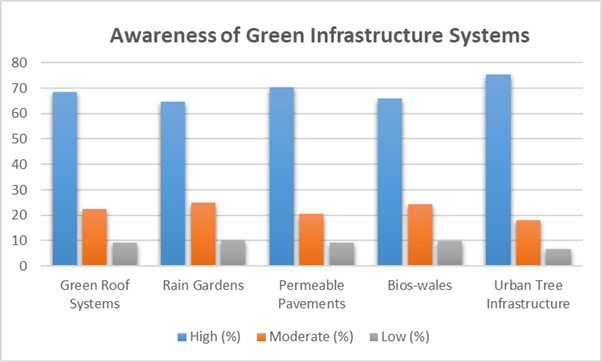
Figure 1. Respondent awareness of six common green infrastructure system types (N = 215). Awareness was self-reported on a three-point scale (high, moderate, low) for green roofs, rain gardens, bioswales, permeable pavements, urban trees, and retention ponds. Bars represent the percentage of respondents in each awareness category for each system type. Urban trees recorded the highest high-awareness rating (75.3%), while bioswales (66.0%) and rain gardens (64.7%) showed somewhat lower familiarity, likely reflecting their finer spatial scale of implementation.
reporting high awareness — a finding that seems intuitive given how long urban tree canopies have been a visible part of city landscapes, regardless of whether they are explicitly framed as "infrastructure" (Pauleit et al., 2021). Permeable pavements followed at 70.2%, and green roofs at 68.4%, both of which have received considerable visibility through demonstration projects and municipal pilot programs over the past decade.
Bioswales (66.0%) and rain gardens (64.7%) registered somewhat lower, though still substantial, awareness. The gap is modest but probably meaningful: these systems tend to operate at finer spatial scales — neighborhood parcels, individual street segments — and are arguably less legible to professionals working outside direct site design. Across all categories, moderate awareness ranged from roughly 18% to 25%, while low-awareness responses stayed under 11% for every system type. Whatever else this sample may not represent, it is not a group unfamiliar with the basic GI toolkit.
3.3 Perceived Effectiveness for Flood Mitigation
When asked to evaluate how well each GI system performs in mitigating urban flooding, respondents were broadly positive, though with meaningful variation among system types (Table 2). Retention ponds drew the strongest endorsement: 64.5% of respondents rated them "very effective," with another 26.0% selecting "effective." Permeable pavements came in second, with 61.7% rating them "very effective" and an additional 28.4% rating them "effective." Rain gardens, bioswales, and green roofs received slightly lower very-effective ratings (58.3%, 55.8%, and 52.1%, respectively) but still attracted strong overall positive evaluations once the "effective" category was added in.
Neutral responses remained under 14% across all five system types, and outright negative ratings were essentially absent. The pattern is consistent with a literature that increasingly favors hybrid or nature-based approaches over purely engineered alternatives, particularly for managing the kind of short-duration, high-intensity storm events that conventional drainage struggles with (Lee et al., 2021). One caveat is worth flagging: these are perceived effectiveness ratings, not measured performance, and a respondent's confidence in a system may reflect exposure to successful installations as much as the system's inherent capacity (Herath et al., 2023).
3.4 Adoption Levels Across Urban Contexts
Adoption patterns showed a clearer gradient across urban typologies than any other variable in the dataset (Figure 2). Major metropolitan regions reported the highest rate of high-level adoption at 72.6%, followed closely by coastal cities at 69.1%. The proximity between these two figures is not surprising; both contexts tend to combine concentrated flood exposure with relatively well-resourced municipal departments and active climate-adaptation agendas (Sánchez & Govindarajulu, 2022).
Suburban areas occupied a middle position at 54.3%, while inland cities reported 49.5%. Small cities recorded the lowest high-adoption rate at 38.7% and, correspondingly, the highest low-adoption rate at 20.8%. The differential between metropolitan and small-city contexts — close to thirty-four percentage points — is striking, and it is consistent with prior observations that smaller and inland municipalities face a compounding mix of constrained budgets, thinner technical staffing, and weaker policy incentives for green alternatives (Song et al., 2022; Liu et al., 2019). What the data cannot tell us, of course, is whether the gap reflects unmet need or simply different priorities given different risk profiles; both are likely contributing.
3.5 Perceived Environmental and Social Benefits
Respondents were generally enthusiastic about the broader benefits of green infrastructure, with most benefit indicators drawing strong agreement (Figure 3). Improved urban livability received the highest endorsement, with 72.5% of respondents in strong agreement. Reduction of urban heat followed at 70.4%, and enhanced water quality at 68.9%. Flood risk reduction itself was endorsed at 66.8%, and support for urban biodiversity at 64.2%.
Across all five benefit indicators, neutral responses sat in a narrow band between roughly 6.9% and 8.8%, suggesting fairly broad consensus rather than a polarized response pattern. The fact that benefits beyond flood control — heat reduction, water quality, biodiversity, livability — drew comparably strong support is worth noting. It implies that practitioners are reading GI as a multifunctional intervention rather than a narrowly hydraulic one, which aligns with the framing increasingly adopted in the urban sustainability literature (Rayan et al., 2022; Belčáková et al., 2019).
Table 2. Respondent-rated effectiveness of five green infrastructure (GI) system types for urban flood mitigation. Ratings were collected on a five-point Likert scale, with the three most populated response categories shown: "very effective," "effective," and "neutral." Values represent the percentage of respondents (N = 215) selecting each rating for each system type. Negative responses ("ineffective" and "very ineffective") accounted for less than 2% across all system types and are not displayed. Higher very-effective percentages indicate stronger perceived performance.
|
System Type
|
Very Effective (%)
|
Effective (%)
|
Neutral (%)
|
|
Green Roofs
|
52.1
|
34.0
|
13.9
|
|
Rain Gardens
|
58.3
|
30.2
|
11.5
|
|
Permeable Pavements
|
61.7
|
28.4
|
9.9
|
|
Bios-wales
|
55.8
|
33.1
|
11.1
|
|
Retention Ponds
|
64.5
|
26.0
|
9.5
|
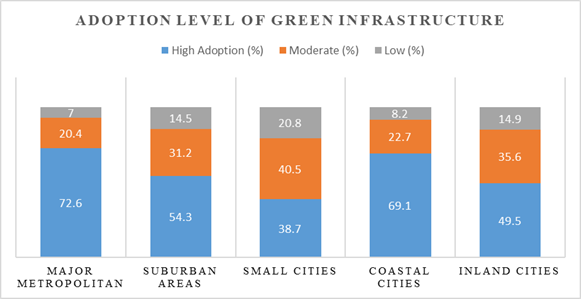
Figure 2. Reported green infrastructure adoption levels across five U.S. urban typologies (N = 215). Respondents classified GI adoption in their primary working context as high, moderate, or low. Urban typologies include major metropolitan regions, coastal cities, suburban areas, inland cities, and small cities. Major metropolitan regions reported the highest high-adoption rate (72.6%), while small cities reported the lowest (38.7%) — a differential of close to thirty-four percentage points that points to a substantial geographic equity gap in GI implementation.
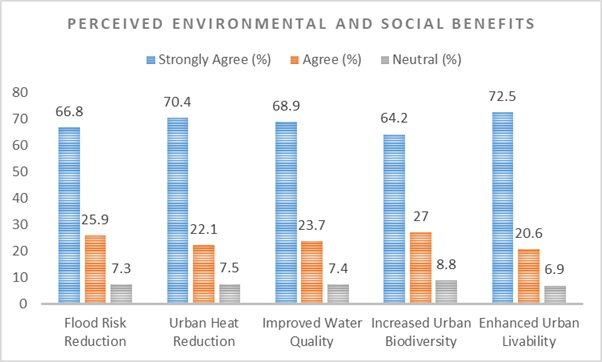
Figure 3. Respondent perceptions of the environmental and social benefits of green infrastructure (N = 215). Agreement with five benefit statements was rated on a five-point Likert scale ranging from "strongly agree" to "strongly disagree." Bars display the percentage of respondents selecting each response category for each benefit indicator: improved urban livability, urban heat reduction, water quality enhancement, flood risk reduction, and support for urban biodiversity. Improved urban livability received the highest strong-agreement rating (72.5%), suggesting that practitioners are interpreting GI as a multifunctional intervention rather than a narrowly hydraulic solution.
Table 3. Pearson correlation results for the six hypothesized associations among study constructs (N = 215). Constructs include Green Infrastructure adoption (GI), Flood Mitigation Response (FMR), Climate Stress Mitigation (CSM), Awareness (AWA), Barrier Index (BRI), and Sustainability Benefit Level (SBL). Coefficients (r) are reported with associated p-values; all six associations reached significance at p < 0.001. Hypotheses are framed as conceptual associations within the study's analytical framework; directional arrows in the "Path Relationship" column reflect the conceptual model rather than statistically confirmed causal pathways.
|
Hypothesis
|
Path Relationship
|
r- value
|
p-value
|
Result
|
|
H1
|
NGI → FMR
|
0.68
|
<0.001
|
Supported
|
|
H2
|
NGI → CSM
|
0.65
|
<0.001
|
Supported
|
|
H3
|
AWA → NGI
|
0.62
|
<0.001
|
Supported
|
|
H4
|
BRI → NGI
|
-0.55
|
<0.001
|
Supported (Negative Effect)
|
|
H5
|
FMR → SBL
|
0.72
|
<0.001
|
Strongly Supported
|
|
H6
|
CSM → SBL
|
0.69
|
<0.001
|
Strongly Supported
|
3.6 Hypothesis Testing: Associations Among Constructs
Pearson correlation analyses examined associations among the six study constructs at a significance threshold of p < 0.001 (Table 3). All six pre-specified associations reached statistical significance.
Green Infrastructure adoption was positively associated with Flood Mitigation Response (r = 0.68) and with Climate Stress Mitigation (r = 0.65), supporting H1 and H2 respectively. Awareness showed a moderately strong positive association with GI adoption (r = 0.62, H3), while the Barrier Index showed a moderately strong negative association (r = −0.55, H4). The two strongest associations in the dataset linked outcome perceptions to overall sustainability benefit: Flood Mitigation Response correlated with Sustainability Benefit Level at r = 0.72 (H5), and Climate Stress Mitigation with Sustainability Benefit Level at r = 0.69 (H6).
A note of interpretive caution belongs here. These coefficients describe associations among perceptual constructs, not measured causal pathways, and the directionality implied in the hypothesis framing (for example, "AWA → GI") should be read as conceptual rather than statistically confirmed (Addabbo et al., 2023). What the pattern does suggest, fairly clearly, is that awareness and barrier perceptions are moving in opposite directions on adoption, and that the perceived flood and climate functions of GI are tracking closely with broader sustainability evaluations.