Energy Environment and Economy

Energy, Environment and Sustainable Sciences | online ISSN 3069-0935
2
Citations
16.5k
Views
16
Articles
Your new experience awaits. Try the new design now and help us make it even better
Switch to the new experience
Figures and Tables
RESEARCH ARTICLE   (Open Access)

Integrated Artificial Intelligence and Stochastic Optimization Framework for Resilient and Low Carbon Renewable Energy Manufacturing Systems

Shipon Chandra Barman1*, Anisul Islam Opy2

+ Author Affiliations

Energy Environment and Economy 1 (1) 1-8 https://doi.org/10.25163/energy.1110684

Submitted: 09 November 2022 Revised: 19 January 2023  Published: 24 January 2023 


Abstract

Background: As the power grid embraces renewable energy, systems for manufacturing these are being confronted with more and more uncertainty from both fluctuating market demand and sporadic supply of variable renewables to equipment breakdowns as well as strict low carbon emission requirements. Although AI and stochastic optimization appear promising in isolation, their combined application for improving the resilience and low-carbon level of production is still scarce. Methods: An AI-based stochastic optimization framework that combines machine-learning predictions with two-stage stochastic programming was designed. Artificial neural networks anticipated demand, and Random Forest models predicted equipment failures. Probabilistic outputs were implemented in order to optimize production, energy usage, and emissions with operational (2018–2022) and survey data provided by 210 U.S. solar manufacturing professionals evaluated by means of reliability, factor, and scenario analyses. Results: The resulting framework achieved substantial improvement over the results of deterministic planning models. Total operating costs were decreased by 16.2%, with energy expenditure reduced by around 20%. Carbon emissions were down by almost 20%, and renewable energy use went up from 41% to 56.8%. Operational resilience also increased as unmet demand decreased from 9.8 to 7.3% and recovery time following a severe disruption decreased from 7.2 to 4.9 days. Conclusions: AI-integrated prediction together with stochastic optimization makes a self-sustainability system possible in terms of both economic efficiency and resilience along with low-carbon performance, providing such scaled solutions for the sustainable renewable energy manufacturing systems.

Keywords: Stochastic Optimization, Artificial Intelligence, Renewable Energy Manufacturing, Operational Resilience, Low-Carbon Production

1. Introduction

The fast growth of renewable energy production facilities serves as a worldwide initiative that works to lower greenhouse gas emissions and boost national power security (Kong et al., 2021). Production facilities that manufacture solar panels and wind turbines and energy storage equipment and power electronics must function through unpredictable situations because of changing energy market costs and broken supply networks and unpredictable solar and wind power production (Andronie et al., 2021). The manufacturing industry faces rising demands to build operational stability while following environmental rules, which demand reduced carbon emissions and sustainable business practices (Bazmi & Zahedi, 2011). Different demands have become a tough obstacle for traditional deterministic planning methods because these systems lack the ability to deal with unpredictability in situations that require changing decisions (Wu et al., 2016). Artificial intelligence (AI) technology has opened up fresh methods to solve these existing problems (Wang et al., 2017). Manufacturers can use AI-based forecasting together with predictive maintenance and intelligent decision-support systems to predict market changes and allocate resources better and prevent unexpected breakdowns. Production systems use AI-driven analytics to detect upcoming uncertainties, which they use for effective control instead of dealing with unexpected event responses (Andronie et al., 2021). The manufacturing industry employs AI technology at rising rates, yet most systems still use basic optimization models, which fail to use AI predictive abilities during uncertain production situations (Demartini et al., 2019).

Stochastic optimization has emerged as a powerful framework for decision-making under uncertainty, enabling the explicit modeling of variability in demand, energy availability, and system disruptions (Romero et al., 2014). By incorporating probabilistic scenarios, stochastic models improve the robustness of production planning and energy management strategies. When combined with AI-based predictions, stochastic optimization can transform uncertainty from a risk into a strategic advantage (De Sousa  et al., 2020). However, existing studies often examine AI applications and stochastic optimization separately, with limited integration of these approaches in the context of renewable energy manufacturing systems (Hua et al., 2021). Resilience is often measured in recovery time or production loss, whereas sustainability is quantified through energy efficiency and reduction of emission (Mina et al., 2021). Enhancing prediction and flexible production schedules can reduce energy wastage, lower emissions, and speed up the recovery from disturbances at the same time (Hsueh et al., 2021). There remains limited empirical evidence to quantify these interlinked benefits, especially in the case of U.S.-based renewable energy manufacturing firms (Shidhani et al., 2020).

The business environment shows an urgent requirement for integrated decision frameworks because organizations need these solutions to survive. The majority of industrial power consumption comes from manufacturing facilities because they use large amounts of energy at their facilities. This study indicates that intelligent optimization methods will reduce operational power expenses by about 15 to 20 percent when used for energy-demanding manufacturing operations. Organizations need to establish both technological readiness and organizational support for benefits to become real because management needs to understand how system-level performance results affect their work. This study aims to develop an AI-based stochastic optimization system for renewable energy manufacturing units that uses AI prediction systems to make probabilistic decisions for achieving optimal economic results and operational stability and environmental sustainability during unpredictable operations.

2. Materials and Methods

2.1 Study Design for Stochastic Optimization

This study applied a numerical approach which used statistical analysis to investigate artificial intelligence systems combine with stochastic optimization methods for renewable energy system production facilities throughout the United States. The system evaluation framework established assessment methods to determine operational resilience and cost efficiency and carbon emission reduction performance when facing unpredictable market demand and equipment failure scenarios (Longa & Van Der Zwaan, 2017). Scenario based stochastic models to study AI prediction systems improve production scheduling and power consumption optimization (Gabbar et al., 2021). This study focused its attention on solar photovoltaic (PV) systems together with wind turbine installations and energy storage facilities (Beiki et al., 2021). We used a combined method which brought together machine learning prediction systems with maintenance prediction systems and stochastic programming models to create a manufacturing environment which resembled actual production facilities (Fazli-Khalaf et al., 2017). This study finding will direct strategic decisions which will create production systems that achieve both low carbon emissions and high resilience.

2.2 Survey and Respondents with characteristics

This study distributed a planned survey to 210 working people represented different manufacturing fields which included solar PV production and wind turbine manufacturing and energy storage system development. The study included participants who worked as production managers (48 people), operations engineers (52 people), energy managers (44 people), technical staff members (30 people), and planning officers (36 people). The survey collected data about organizational features and AI system implementation and operational stability methods and energy consumption management approaches and environmentally friendly practices to reduce carbon emissions. The survey respondents used a five-point Likert scale to express their answers which ranged from 1 for strongly disagree to 5 for strongly agree (Kumar et al., 2020). This investigator achieved sufficient sample size through Kaiser Meyer Olkin scores above 0.75 and Bartlett’s test of sphericity which showed statistical significance to conduct multivariate analysis and produce reliable statistical results (Veldhuis & Yang, 2017).

2.3 Data Sources

Three main data streams served as the basis for this study to achieve total operational management of manufacturing facilities. We collected operational data from 2018 through 2022 which contained monthly production statistics together with machine breakdown information and energy usage data and maintenance service documentation. The survey responses showed managers viewed their organizations' AI adoption practices and their ability to handle challenges and their environmental sustainability efforts (Rathor & Saxena, 2020). The energy and emission data set contained two main types of information because it showed the cost of grid electricity and the amount of renewable power available at the site and it also showed much carbon dioxide the operations produced (Kusiak, 2019). All available data sources to develop a modeling system which used data-based approaches. Developed AI-based stochastic optimization models through their analysis of operational data and survey results which showed actual system operations under various conditions (Liao & Ji, 2020).

2.4 AI-Based Prediction Models

Stochastic optimization framework received predictive inputs through machine learning methods which generated these inputs. The training process of Artificial Neural Network (ANN) involved historical production data together with market trend information to create product demand forecasts (Vinuesa et al., 2020). Random Forest (RF) model generated machine failure probability estimates by analyzing operational hours together with maintenance records and previous downtime occurrences (Zhang et al., 2020). The model evaluation process used RMSE and MAPE metrics to determine whether it delivered trustworthy prediction results (Jabbarzadeh et al., 2018). AI system generated probability-based demand forecasts while it determined possible system failures which scientists used to develop operational risk models. The system links exact forecast data with optimization systems to produce better decisions during uncertain situations while it reduces both production downtime and manufacturing errors (Svartzman et al., 2020).

2.5 Stochastic Optimization Framework

A two-stage stochastic programming model was formulated to optimize production, energy sourcing, and low-carbon strategies under uncertainty. In Stage 1, decisions were made before uncertainty realization, including production allocation, workforce deployment, and energy procurement. Stage 2 incorporated recourse actions following the realization of demand and machine failure scenarios, such as overtime production, shift adjustments, and flexible energy use (Ponnusamy et al., 2021). The objective function minimized expected total cost, including production, energy, carbon emissions, and penalty costs. Model includes three main constraints which establish production capacity limits and energy flow equilibrium and demand fulfillment based on different scenarios and emission caps (Wolsink, 2017). The framework enabled simultaneous evaluation of economic and environmental and resilience targets which generated operational schemes that could handle unpredictable changes in customer demand and equipment failure rates (Hung & Söffker, 2021).

2.6 Scenario Generation, Carbon Accounting, and Data Analysis

The creation of probabilistic scenarios involved three demand levels which combined with two operational states to generate six complete scenarios that contained probability values based on past system changes (Nikolaidis & Poullikkas, 2021). The formula for carbon emissions calculation shows in Equation 1.

CO2?Emissions = ? (Energy use × Emission Factor) ……(Eq.1.)

Where, energy consumption include power drawn from both electrical networks and the renewable energy systems which operate at the facility. Evaluation process included a carbon pricing system which showed economic and environmental trade-offs through its assessment (Nafus et al., 2021). Descriptive statistics to analyze survey and operational data while reliability analysis checked internal consistency and researchers applied exploratory factor analysis (EFA) to find hidden elements which included AI adoption and resilience and low-carbon performance (Kennedy et al., 2017). This results from scenario-based stochastic optimization methods showed better performance than deterministic baselines through their improved cost management and reduced emissions and enhanced system resilience (Abanda et al., 2021).

3. Results

3.1 Demographic, Professional, and Organizational Profile of Respondents

This study gathered 210 survey responses which stemmed from renewable energy manufacturing companies based in the United States. Participants worked in different sectors which included solar PV manufacturing at 39% and wind turbine manufacturing at 25.7% and energy storage and battery technologies at 18.1% and power electronics at 17.2%. The renewable energy sector consists of multiple distinct segments which these numbers illustrate. The workforce consisted of five different job categories which included production managers at 22.9% and operations engineers at 24.8% and energy managers at 21% and technical staff members at 14.3% and planning officers at 17.1% as shown in Table 1. The organization received input from both its operational teams and strategic planning groups. The organization consisted of companies which operated between two extremes because their employee numbers reached from zero to more than 1000 people. This study needs diverse participants to assess their viewpoints about AI implementation and predictive maintenance and operational strength and environmentally friendly practices which will support upcoming reliability assessments and factor analysis and stochastic optimization modeling. Renewable energy manufacturing facilities to collect information about operational challenges and management issues which occur in actual workplace settings.


Table 1.  Demographic, Professional, and Organizational Profile of Respondents

Category

Sub-Category

Frequency (n)

Percentage (%)

Sector

Solar PV Manufacturing

82

39.0

Wind Turbine Manufacturing

54

25.7

Energy Storage / Battery

38

18.1

Power Electronics

36

17.2

Job Role

Production Managers

48

22.9

Operations Engineers

52

24.8

Energy Managers

44

21.0

Technical Staff

30

14.3

Planning Officers

36

17.1

Firm Size

<250 employees

46

21.9

250–500 employees

61

29.0

501–1000 employees

58

27.6

>1000 employees

45

21.5

Experience

<5 years

46

21.9

5–10 years

89

42.4

>10 years

75

35.7

3.2 Reliability Analysis of Survey Constructs

The results from Table 2 display the internal consistency of survey constructs which measure AI adoption and predictive maintenance and operational resilience and low-carbon manufacturing practices. Instruments showed strong reliability because all their constructs achieved Cronbach's alpha scores which fell between 0.78 and 0.89. This results demonstrated that AI-based demand forecasting and low-carbon manufacturing practices achieved outstanding reliability scores of 0.88 and 0.89 respectively which proved their ability to measure participant views effectively. Process needs a reliability evaluation to prove its statistical validity before conducting factor analysis and regression modeling. Demonstrated strong design quality because multiple sectors and job roles and experience levels provided consistent answers which produced a high Cronbach's alpha for all constructs. This results establish a solid basis for studying, AI implementation affects organizational strength and sustainable environmentally friendly practices because the survey instrument demonstrated high quality and rigorous standards.


Table 2. Reliability Analysis of Survey Constructs

Construct

Items

Cronbach’s a

AI-Based Demand Forecasting

5

0.88

Predictive Maintenance

4

0.82

Manufacturing Resilience

6

0.86

Disruption Preparedness

4

0.80

Energy Management Efficiency

5

0.78

Low-Carbon Manufacturing Practices

6

0.89

3.3 Descriptive Statistics of Key Variables with Likert Scale

Distribution patterns together with the range of survey answers which evaluate AI systems against their resilience and their ability to support low-carbon operations as presented in Table 3. AI forecast accuracy at 4.12 and carbon emission reduction efforts at 4.15 which shows their strong belief in AI-based predictive systems and environmentally friendly manufacturing operations. predictive maintenance achieved an average score of 4.05 and energy efficiency improvement obtained a score of 4.08 which proves people understand the value of proactive operational methods. The study data showed standard deviation values between 0.60 and 0.71 which demonstrated that participants maintained similar response patterns while their answers spread moderately across different response options. Statistical summary shows that people continuously identify AI technology together with low-carbon solutions as essential tools which create operational efficiency and environmental sustainability and improve system resilience. Instrument receives validation through these assessment tools which also generate data for exploratory factor analysis and optimization modeling studies that demonstrate survey results affect actual decision-making in renewable energy production facilities.


Table 3. Descriptive Statistics of Key Variables (Likert Scale 1–5)

Variable

Mean

Std. Deviation

AI Forecast Accuracy

4.12

0.63

Predictive Maintenance Effectiveness

4.05

0.68

Production Flexibility

3.97

0.71

Disruption Recovery Capability

4.01

0.66

Energy Efficiency Improvement

4.08

0.65

Carbon Emission Reduction Efforts

4.15

0.60


3.4 Factor Loadings from Exploratory Factor Analysis

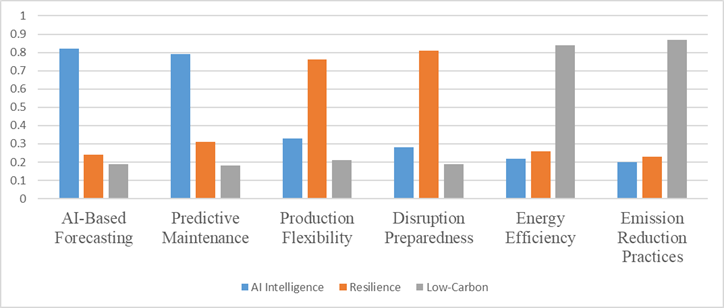
Exploratory factor analysis (EFA) results in Figure 1 show three hidden factors which include AI intelligence and operational resilience and low-carbon performance. AI intelligence factor shows that AI-based forecasting and predictive maintenance have strong loadings of 0.82 and 0.79 respectively which proves their critical role in decision-support systems. Analysis of operational resilience revealed that production flexibility received a score of 0.76 while disruption preparedness scored 0.81 which shows respondents strongly recognize the importance of being able to adjust and bounce back. Operational changes to environmental results through their association of low-carbon manufacturing with two main factors which include energy efficiency and emission reduction practices. Factor loadings establish proper survey construct architecture which enables AI and stochastic optimization model combination for better resilience and sustainability performance. Data shows that AI intelligence maintains a strong relationship with resilience and low-carbon practices which supports the combined modeling method.


Figure 1. Factor Loadings from Exploratory Factor Analysis

3.5 Comparison of Deterministic and AI Stochastic Optimization

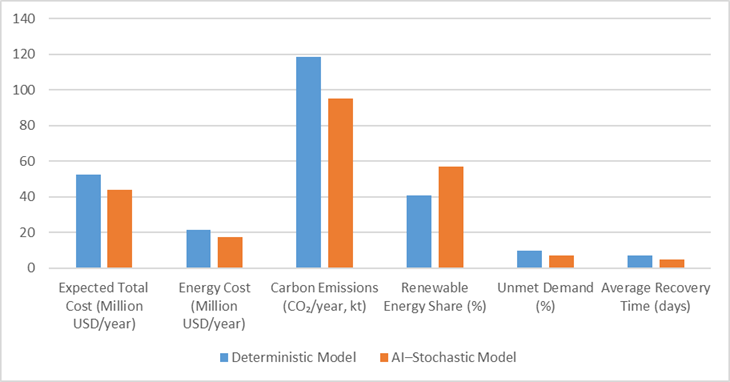
Comparison between the basic deterministic planning system and the AI stochastic optimization framework as shown in Figure 2. AI stochastic model implementation cut down the total projected costs from 52.4 million USD/year to 43.9 million USD/year while reducing energy expenses from 21.6 million USD/year to 17.3 million USD/year. The 20% reduction in carbon emissions from 118.6 to 95.2 kt CO2/year demonstrates how optimized energy procurement and production scheduling methods successfully reduced emissions. The percentage of renewable energy supply grew from 41% to 56.8% while the amount of unfulfilled demand decreased from 9.8% to 7.3% which shows better operational results. The recovery period shortened from 7.2 to 4.9 days which shows that the system developed better resilience. The evaluation results show that AI prediction systems which work with stochastic optimization methods produce better economic results and environmental sustainability and operational system durability which proves the value of the renewable energy manufacturing framework.


Figure 2.  Comparison of Deterministic and AI–Stochastic Optimization

3.6 Resilience Performance under Disruption Scenarios

Performance during standard operations and when facing both small and large system failures. The system maintained operational stability during major disruptions through its framework which resulted in 11.5% production loss and 9.8% unmet demand and 7.2 days of recovery time as shown in Table 4. The system experienced moderate losses because of small disruptions which resulted in 6.4% production loss and 4.2 days of recovery time. The system operated with its normal performance because it only experienced small changes which resulted in 2.1% production loss and 1.6 days of recovery time. The system-maintained control over its energy consumption while its pollution output remained constant across all operating scenarios. The research findings show that AI-driven stochastic optimization methods improve operational resilience because they reduce disruption effects while achieving low-carbon targets which supports US renewable energy manufacturers with a strong operational framework.


Table 4. Resilience Performance under Disruption Scenarios

Indicator

Normal Operation

Minor Disruption

Major Disruption

Production Loss (%)

2.1

6.4

11.5

Cost Increase (%)

1.8

7.9

14.2

Recovery Time (days)

1.6

4.2

7.2

Energy Overuse (%)

2.4

6.8

10.9

Emission Increase (%)

1.9

5.7

9.6

Unmet Demand (%)

1.5

4.9

9.8


4. Discussion

Demonstrate that AI-based stochastic optimization systems produce three simultaneous advantages which include improved operational efficiency and enhanced system stability and reduced carbon emissions in the production of renewable energy systems as indicate Kennedy et al. (2017). Measurable performance improvements through both survey data and system optimization results which other studies tend to overlook when they focus on qualitative advantages (Yigitcanlar et al., 2020). This results obtained their basic value from the respondent characteristics which Table 1 summarizes. Demonstrate equal representation between solar PV (39%), wind manufacturing (25.7%), energy storage (18.1%), and power electronics (17.2%) which proves the findings extend beyond specific industry sectors. The distribution of job roles together with experience levels enables organizations to identify AI advantages which benefit their operational functions and strategic management activities. The entire scope of research work enables researchers to establish reliable AI value claims together with system performance results (Wang et al., 2017).

Reliability findings which support the research method because all survey constructs achieved strong internal consistency through their Cronbach’s alpha values which range from 0.78 to 0.89 in Table 2. AI-based demand forecasting and low-carbon manufacturing practices achieve high reliability scores of 0.88 and 0.89 respectively because respondents consistently link AI intelligence to sustainability results. Integration of AI with resilience and decarburization functions through a single analytical system which establishes accurate results from upcoming assessments (Beiki et al., 2021). Descriptive statistics in Table 3 show that value alignment reaches its maximum level. The data shows that AI forecast accuracy reached 4.12 and predictive maintenance effectiveness achieved 4.05 and energy efficiency improvement reached 4.08 and emission reduction efforts achieved 4.15 which shows strong belief in AI operational practices. The low standard deviation values which range from 0.60 to 0.71 show that organizations maintain similar perceptions which supports the operational deployment of AI–stochastic frameworks for their practical scalability. Organizations need to accept this value because they must accept it before they can achieve enhanced system performance (De Sousa Jabbour et al., 2020).

Exploratory factor analysis results as Figure 1, provide strong structural value by empirically validating three distinct but interconnected constructs: AI intelligence, operational resilience, and low-carbon performance. Establishes AI intelligence as the fundamental operational base through high factor loadings which measure 0.82 for AI-based forecasting and 0.79 for predictive maintenance. The research shows AI-based decision systems create operational results through their ability to prepare for disruptions at 0.81 and their emission reduction practices at 0.87. This framework which show mathematical relationships between intelligence levels and adaptability scores and environmental performance results based on Subramanian et al. (2018). The most significant value creation is observed in the comparison between deterministic and AI–stochastic optimization models (Figure 2). AI–stochastic system brought down total expenses by 16.2 percent through a drop from 52.4 million USD to 43.9 million USD per year and it also decreased power expenses by 20 percent through a reduction from 21.6 million USD to 17.3 million USD per year. The same period showed a 20 percent decrease in carbon emissions which dropped from 118.6 to 95.2 kt CO2/year while renewable energy usage expanded from 41% to 56.8%. The research data reveals that economic targets and environmental goals emerge at the same time instead of following a step-by-step process or causing damage to one another. The operational performance value became visible through its ability to reduce unfulfilled demand from 9.8% to 7.3% and its fast recovery time which shortened from 7.2 days to 4.9 days. The research shows that AI–stochastic optimization systems improve their ability to handle uncertain situations by enhancing system reliability and responsiveness which solves the main problem of deterministic planning systems (Bibri, 2021).

Resilience value receives additional confirmation through testing which simulates system failures according to Table 4. The production system maintained its operation during major disruptions because it only experienced a total loss of 11.5% and its demand remained below 10% while its recovery period stayed under 7.2 days. The system shows strong adaptability because its performance degradation during controlled testing produced results which matched the usual production loss of 2.1% and standard recovery time of 1.6 days. The system maintains its energy consumption and emission levels below acceptable limits so it proves that its improved resilience does not affect its capability to reach environmental targets (Basu et al., 2011). The study presents numerical evidence which shows AI-based stochastic optimization systems create various operational improvements through their technology. Research has demonstrated through statistical evidence that AI intelligence contributes to achieving two crucial manufacturing goals which include system resilience and low-carbon operations. The evidence based on value assessment enables better decision-making practices for renewable energy manufacturing operations while it also supports academic research about these operations.

5. Conclusion

This study proves that combining AI-based prediction systems with stochastic optimization methods produces measurable benefits for renewable energy manufacturing systems which affect their economic performance. Demonstrate that the developed system reduces both total expenses and energy consumption while it boosts renewable power availability and achieves twenty percent carbon emission reductions by optimizing demand response and shortening system recovery intervals. AI intelligence as the fundamental operational resilience and low-carbon performance factor through its validation survey and factor analysis results. AI-based stochastic optimization as an operationally suitable solution which can expand to create sustainable renewable energy manufacturing facilities with durable protection.

References


Abanda, F., Sibilla, M., Garstecki, P., & Anteneh, B. (2021). A literature review on BIM for cities Distributed Renewable and Interactive Energy Systems. International Journal of Urban Sustainable Development, 13(2), 214–232. https://doi.org/10.1080/19463138.2020.1865971

Andronie, M., Lazaroiu, G., Iatagan, M., Hurloiu, I., & Dijmarescu, I. (2021). Sustainable Cyber-Physical Production Systems in Big Data-Driven Smart Urban Economy: A Systematic Literature Review. Sustainability, 13(2), 751. https://doi.org/10.3390/su13020751

Andronie, M., Lazaroiu, G., ?tefanescu, R., U?a, C., & Dijmarescu, I. (2021). Sustainable, Smart, and Sensing Technologies for Cyber-Physical Manufacturing Systems: A Systematic Literature Review. Sustainability, 13(10), 5495. https://doi.org/10.3390/su13105495

Basu, A. K., Chowdhury, S., Chowdhury, S., & Paul, S. (2011). Microgrids: Energy management by strategic deployment of DERs—A comprehensive survey. Renewable and Sustainable Energy Reviews, 15(9), 4348–4356. https://doi.org/10.1016/j.rser.2011.07.116

Bazmi, A. A., & Zahedi, G. (2011). Sustainable energy systems: Role of optimization modeling techniques in power generation and supply—A review. Renewable and Sustainable Energy Reviews, 15(8), 3480–3500. https://doi.org/10.1016/j.rser.2011.05.003

Beiki, H., Seyedhosseini, S. M., Ponkratov, V. V., Zekiy, A. O., & Ivanov, S. A. (2021). Addressing a sustainable supplier selection and order allocation problem by an integrated approach: a case of automobile manufacturing. Journal of Industrial and Production Engineering, 38(4), 239–253. https://doi.org/10.1080/21681015.2021.1877202

Bibri, S. E. (2021). Data-driven smart sustainable cities of the future: urban computing and intelligence for strategic, short-term, and joined-up planning. Computational Urban Science, 1(1). https://doi.org/10.1007/s43762-021-00008-9

De Sousa Jabbour, A. B. L., Jabbour, C. J. C., Sarkis, J., Latan, H., Roubaud, D., Filho, M. G., & Queiroz, M. (2020). Fostering low-carbon production and logistics systems: framework and empirical evidence. International Journal of Production Research, 59(23), 7106–7125. https://doi.org/10.1080/00207543.2020.1834639

Demartini, M., Evans, S., & Tonelli, F. (2019). Digitalization Technologies for industrial Sustainability. Procedia Manufacturing, 33, 264–271. https://doi.org/10.1016/j.promfg.2019.04.032

Fazli-Khalaf, M., Mirzazadeh, A., & Pishvaee, M. S. (2017). A robust fuzzy stochastic programming model for the design of a reliable green closed-loop supply chain network. Human and Ecological Risk Assessment an International Journal, 23(8), 2119–2149. https://doi.org/10.1080/10807039.2017.1367644

Gabbar, H. A., Adham, M. I., & Abdussami, M. R. (2021). Optimal planning of Integrated Nuclear-Renewable Energy system for marine ships using artificial intelligence algorithm. Energies, 14(11), 3188. https://doi.org/10.3390/en14113188

Hsueh, S., Feng, Y., Sun, Y., Jia, R., & Yan, M. (2021). Using AI-MCDM model to boost sustainable energy system development: A case study on solar energy and rainwater collection in Guangdong province. Sustainability, 13(22), 12505. https://doi.org/10.3390/su132212505

Hua, H., Wei, Z., Qin, Y., Wang, T., Li, L., & Cao, J. (2021). Review of distributed control and optimization in energy internet: From traditional methods to artificial intelligence-based methods. IET Cyber-Physical Systems Theory & Applications, 6(2), 63–79. https://doi.org/10.1049/cps2.12007

Hung, M., DO, & Söffker, D. (2021). State-of-the-art in integrated prognostics and health management control for utility-scale wind turbines. Renewable and Sustainable Energy Reviews, 145, 111102. https://doi.org/10.1016/j.rser.2021.111102

Jabbarzadeh, A., Fahimnia, B., & Sabouhi, F. (2018). Resilient and sustainable supply chain design: sustainability analysis under disruption risks. International Journal of Production Research, 56(17), 5945–5968. https://doi.org/10.1080/00207543.2018.1461950

Kennedy, C., Stewart, I. D., Facchini, A., & Mele, R. (2017). The role of utilities in developing low carbon, electric megacities. Energy Policy, 106, 122–128. https://doi.org/10.1016/j.enpol.2017.02.047

Kong, K. G. H., How, B. S., Teng, S. Y., Leong, W. D., Foo, D. C., Tan, R. R., & Sunarso, J. (2021). Towards data-driven process integration for renewable energy planning. Current Opinion in Chemical Engineering, 31, 100665. https://doi.org/10.1016/j.coche.2020.100665

Kumar, N. M., Chand, A. A., Malvoni, M., Prasad, K. A., Mamun, K. A., Islam, & Chopra, S. S. (2020). Distributed energy resources and the application of AI, IoT, and blockchain in smart grids. Energies, 13(21), 5739. https://doi.org/10.3390/en13215739

Liao, L., & Ji, C. (2020). Smart grid dispatching optimization for system resilience improvement. Complexity, 2020, 1–12. https://doi.org/10.1155/2020/8884279

Longa, F. D., & Van Der Zwaan, B. (2017). Do Kenya’s climate change mitigation ambitions necessitate large-scale renewable energy deployment and dedicated low-carbon energy policy? Renewable Energy, 113, 1559–1568. https://doi.org/10.1016/j.renene.2017.06.026

Mina-Casaran, J. D., Echeverry, D. F., & Lozano, C. A. (2021). Demand response integration in microgrid planning as a strategy for energy transition in power systems. IET Renewable Power Generation, 15(4), 889–902. https://doi.org/10.1049/rpg2.12080

Nafus, D., Schooler, E. M., & Burch, K. A. (2021). Carbon-Responsive Computing: Changing the Nexus between Energy and Computing. Energies, 14(21), 6917. https://doi.org/10.3390/en14216917

Nikolaidis, P., & Poullikkas, A. (2021). Evolutionary Priority-Based dynamic programming for the adaptive integration of intermittent distributed energy resources in Low-Inertia power systems. Eng—Advances in Engineering, 2(4), 643–660. https://doi.org/10.3390/eng2040041

Odoi-Yorke, F., & Woenagnon, A. (2021). Techno-economic assessment of solar PV/fuel cell hybrid power system for telecom base stations in Ghana. Cogent Engineering, 8(1). https://doi.org/10.1080/23311916.2021.1911285

Ponnusamy, V. K., Kasinathan, P., Elavarasan, R. M., Ramanathan, V., Anandan, R. K., Subramaniam, U., Ghosh, A., & Hossain, E. (2021). A comprehensive review on sustainable aspects of big data analytics for the smart grid. Sustainability, 13(23), 13322. https://doi.org/10.3390/su132313322

Rathor, S. K., & Saxena, D. (2020). Energy management system for smart grid: An overview and key issues. International Journal of Energy Research, 44(6), 4067–4109. https://doi.org/10.1002/er.4883

Romero-Lankao, P., Gurney, K. R., Seto, K. C., Chester, M., Duren, R. M., Hughes, S., Hutyra, L. R., Marcotullio, P., Baker, L., Grimm, N. B., Kennedy, C., Larson, E., Pincetl, S., Runfola, D., Sanchez, L., Shrestha, G., Feddema, J., Sarzynski, A., Sperling, J., & Stokes, E. (2014). A critical knowledge pathway to low-carbon, sustainable futures: Integrated understanding of urbanization, urban areas, and carbon. Earth S Future, 2(10), 515–532. https://doi.org/10.1002/2014ef000258

Shidhani, T. A., Ioannou, A., & Falcone, G. (2020). Multi-Objective optimisation for power system planning integrating sustainability indicators. Energies, 13(9), 2199. https://doi.org/10.3390/en13092199

Subramanian, A. S. R., Gundersen, T., & Adams, T. A. (2018). Modeling and Simulation of Energy Systems: A review. Processes, 6(12), 238. https://doi.org/10.3390/pr6120238

Svartzman, R., Bolton, P., Despres, M., Da Silva, L. a. P., & Samama, F. (2020). Central banks, financial stability and policy coordination in the age of climate uncertainty: a three-layered analytical and operational framework. Climate Policy, 21(4), 563–580. https://doi.org/10.1080/14693062.2020.1862743

Veldhuis, A. J., & Yang, A. (2017). Integrated approaches to the optimisation of regional and local food–energy–water systems. Current Opinion in Chemical Engineering, 18, 38–44. https://doi.org/10.1016/j.coche.2017.09.001

Vinuesa, R., Azizpour, H., Leite, I., Balaam, M., Dignum, V., Domisch, S., Felländer, A., Langhans, S. D., Tegmark, M., & Nerini, F. F. (2020). The role of artificial intelligence in achieving the Sustainable Development Goals. Nature Communications, 11(1), 233. https://doi.org/10.1038/s41467-019-14108-y

Wang, C., Yan, J., Marnay, C., Djilali, N., Dahlquist, E., Wu, J., & Jia, H. (2017). Distributed Energy and Microgrids (DEM). Applied Energy, 210, 685–689. https://doi.org/10.1016/j.apenergy.2017.11.059

Wolsink, M. (2017). Co-production in distributed generation: renewable energy and creating space for fitting infrastructure within landscapes. Landscape Research, 43(4), 542–561. https://doi.org/10.1080/01426397.2017.1358360

Wu, J., Yan, J., Jia, H., Hatziargyriou, N., Djilali, N., & Sun, H. (2016). Integrated Energy Systems. Applied Energy, 167, 155–157. https://doi.org/10.1016/j.apenergy.2016.02.075

Yigitcanlar, T., Desouza, K., Butler, L., & Roozkhosh, F. (2020). Contributions and Risks of Artificial Intelligence (AI) in Building Smarter Cities: Insights from a Systematic Review of the Literature. Energies, 13(6), 1473. https://doi.org/10.3390/en13061473

Zhang, C., Wang, Z., Ding, K., Chan, F. T., & Ji, W. (2020). An energy-aware cyber physical system for energy Big data analysis and recessive production anomalies detection in discrete manufacturing workshops. International Journal of Production Research, 58(23), 7059–7077. https://doi.org/10.1080/00207543.2020.1748904

Article metrics
View details
0
Downloads
0
Citations
63
Views
📖 Cite article

View Dimensions


View Plumx


View Altmetric


0
Save
0
Citation
63
View
0
Share